
Chapter 5: Users and Passwords
Everything so far has been anonymous. This chapter gives the blog users: a table with a password hash, a model that knows how to hash, sessions and the CSRF protection that comes with them, and registration, login and logout built by hand. Then you specify a profile page with a test and hand it to the agent, and you see what guren context User gives an agent before it touches a model.
Chapter 5: Users and Passwords
Everything so far has been anonymous. This chapter gives the blog users: a table with a password hash, a model that knows how to hash, sessions and the CSRF protection that comes with them, and registration, login and logout built by hand. Then you specify a profile page with a test and hand it to the agent, and you see what guren context User gives an agent before it touches a model.
Guren can install all of this with one command. You are building it yourself, once, so that in chapter 6 you can read that command's output and know what every line is for.
What you'll learn:
- What turning on sessions changes: a cookie, a store, and CSRF protection on every mutating request
- How a password is stored (never the password) and where the hashing happens
- What
this.auth.attempt(),login(),logout()anduserOrFail()do, and what a guard is - Why the tests you wrote in chapter 4 broke, and how a test primes a CSRF token
- How an entity bundle from
guren context Userdiffers from the whole-project map
Start the dev server if it is not running:
bun run dev1. The users table, for real
The scaffold shipped a users table with a name, an email and a timestamp. A user who can sign in needs two more things: a place for the password hash, and an email that cannot be shared by two accounts. Replace db/schema.ts:
db/schema.tsimport { sqliteTable, integer, text } from '@guren/orm/drizzle/sqlite'

export const users = sqliteTable('users', {
  id: integer('id').primaryKey({ autoIncrement: true }),
  name: text('name').notNull(),
  email: text('email').notNull().unique(),
  passwordHash: text('password_hash').notNull(),
  rememberToken: text('remember_token'),
  createdAt: text('created_at').notNull().$defaultFn(() => new Date().toISOString()),
})

export const posts = sqliteTable('posts', {
  id: integer('id').primaryKey({ autoIncrement: true }),
  title: text('title').notNull(),
  body: text('body').notNull(),
  createdAt: text('created_at').notNull().$defaultFn(() => new Date().toISOString()),
})
The column is passwordHash, and its name is the point: the database never holds a password, only the output of a slow, salted hash of one. rememberToken is the "remember me" cookie's secret; it is nullable because most sessions do not use it.
bun run db:make add_passwords_to_usersbun run db:migrateOpen the new migration. It starts with two ALTER TABLE users ADD statements, one per column, and then rebuilds the table anyway: create the new shape, copy the rows across, drop the old one, rename. The first ALTER adds a NOT NULL column with no default, which SQLite accepts only on a table with no rows. Your users table has none yet, so the whole migration applies; chapter 6 changes a table that has data, and there drizzle-kit writes the rebuild alone.
2. The model that hashes
Create app/Models/User.ts:
app/Models/User.tsimport { AuthenticatableModel, defineModel } from '@guren/core'
import { users } from '../../db/schema.js'

export type UserRecord = typeof users.$inferSelect

export class User extends defineModel(users, {
  base: AuthenticatableModel,
  // Derived from the plain `password`, so callers never set it directly
  optionalOnCreate: ['passwordHash'],
  requireOnCreate: ['password'],
  // Never serialized by Model.serialize() and stripped from auth.user()
  hidden: ['passwordHash', 'rememberToken'],
}) {
}
Three options, each doing one job:
base: AuthenticatableModelis what makes this a user rather than a row. It adds a virtualpasswordfield:User.create({ name, email, password: 'secret' })hashes the password and stores the result inpasswordHash. No controller in this chapter calls a hasher; the model owns that.optionalOnCreate/requireOnCreateadjust the create payload's type to match: you must passpassword, you may not passpasswordHash.hiddenkeeps the hash and the remember token out of every serialization, including the user object the auth context hands to pages. In chapter 4 you were promised a resource layer would stoppasswordHashreaching the browser; this is the second lock on the same door.
3. Sessions, and the provider that names the model
A session is how the server remembers who a request belongs to: a cookie holding an id, and a store holding what the id points to. Guren mounts session middleware, and CSRF protection with it, when createApp receives an auth option. The auth system also needs to know which model holds users and which columns to check. That is an app-local provider. Create app/Providers/AuthProvider.ts:
app/Providers/AuthProvider.tsimport { ServiceProvider, shareInertiaProps, AUTH_CONTEXT_KEY } from '@guren/core'
import type { AuthContext, AuthManager } from '@guren/core'
import { User } from '../Models/User.js'

export default class AuthProvider extends ServiceProvider {
  register(): void {
    const auth = this.container.make<AuthManager>('auth')
    auth.useModel(User, {
      usernameColumn: 'email',
      passwordColumn: 'passwordHash',
      rememberTokenColumn: 'rememberToken',
      credentialsPasswordField: 'password',
    })
  }

  boot(): void {
    shareInertiaProps(async (ctx) => {
      const auth = ctx.get(AUTH_CONTEXT_KEY) as AuthContext | undefined
      return { auth: { user: await auth?.user() } }
    }, this.container)
  }
}
useModel registers a guard named web: the thing that, given a request, answers "who is this?" by reading the session, and given credentials, answers "are these right?" by comparing a hash. shareInertiaProps adds auth.user to the props of every page, so any component can ask whether someone is signed in. It is null for a guest, and it never contains the hash because of hidden.
Now turn it on. Replace src/app.ts:
src/app.ts// Every zod schema built after this import parses through a compiled fast
// path. Keep it the first import so it runs before any module that defines
// schemas. It honors z.config({ jitless: true }) for CSP-restricted runtimes
// and never throws — unsupported schemas keep the regular parser. One caveat:
// on invalid input, refinements/transforms can run twice (fast path, then
// fallback), so keep .refine()/.transform() free of side effects.
import 'zod/compile'
import { createApp } from '@guren/core'
import AuthProvider from '../app/Providers/AuthProvider.js'
import database from '../config/database.js'
import env from '../config/env.js'
import http from '../config/http.js'
import { registerWebRoutes } from '../routes/web.js'

const app = createApp({
  // Rendered into every server-rendered document. Replace public/favicon.svg
  // with your own artwork, or add more tags here (Open Graph, apple-touch-icon).
  inertia: {
    document: {
      head: '<link rel="icon" type="image/svg+xml" href="/favicon.svg" />',
    },
  },
  env,
  config: [database, http],
  routes: registerWebRoutes,
  providers: [AuthProvider],
  // Sessions and CSRF protection: an in-memory session store by default,
  // which chapter 14 replaces with a database-backed one.
  auth: {},
  // Translations live in lang/<locale>/*.json. Add locales to `supported`
  // and the request locale is detected from ?locale=, a locale cookie, or
  // Accept-Language. `guren codegen` types the keys for t()/useTranslation().
  i18n: { supported: ['en'] },
})

export default app
What changed: the AuthProvider import, AuthProvider in providers, and auth: {} with the comment above it. Run the tests:
bun test4. What sessions broke, and why that is right
Every test that submitted a form is red with a 403: "CSRF token mismatch". Nothing about posts changed. What changed is that the app now has sessions, and an app with sessions has to defend them.
A cross-site request forgery is another site's page making your browser submit a form to this app. The browser attaches your session cookie; the app cannot tell the request from one you meant. The defence is a token the app puts in a cookie and expects back in a header or a form field on every POST, PUT, PATCH and DELETE. Another site cannot read your cookies, so it cannot produce the token. Inertia's forms do this automatically: form.post() copies the XSRF-TOKEN cookie into the X-XSRF-TOKEN header, which is why the browser never noticed.
Your tests noticed, because they are not a browser. TestApp has withCsrf() for exactly this: it makes one GET, keeps the cookies and the token it was given, and returns a client that sends them with every request. Replace tests/PostController.test.ts; the only change is that the mutating requests go through csrf:
tests/PostController.test.tsimport { beforeAll, beforeEach, describe, expect, it } from 'bun:test'
import { TestApp } from '@guren/testing'
import app from '../src/app.js'
import { resetDatabase } from '../config/database.js'
import { Post } from '../app/Models/Post.js'

describe('PostController', () => {
  let http: TestApp
  let csrf: TestApp

  beforeAll(async () => {
    http = await TestApp.fromApp(app)
    csrf = await http.withCsrf()
  })

  beforeEach(async () => {
    await resetDatabase()
  })

  it('lists posts, newest first', async () => {
    await Post.create({ title: 'First post', body: 'Hello' })
    await Post.create({ title: 'Second post', body: 'Again' })

    const response = await http.get('/posts').assertOk()
    const html = await response.text()
    const first = html.indexOf('First post')
    const second = html.indexOf('Second post')
    if (first === -1 || second === -1 || second > first) {
      throw new Error('expected the newer post to be listed before the older one')
    }
  })

  it('paginates ten posts per page', async () => {
    for (let i = 1; i <= 11; i++) {
      await Post.create({ title: `Post ${String(i).padStart(2, '0')}`, body: `Body number ${i}` })
    }

    const firstPage = await http.get('/posts').assertOk()
    await firstPage.assertBodyContains('Post 11')
    await firstPage.assertBodyContains('Post 02')
    expect(await firstPage.text()).not.toContain('Post 01')

    const secondPage = await http.get('/posts?page=2').assertOk()
    await secondPage.assertBodyContains('Post 01')
    expect(await secondPage.text()).not.toContain('Post 02')
  })

  it('shows one post', async () => {
    const post = await Post.create({ title: 'Read me', body: 'The whole body' })

    const response = await http.get(`/posts/${post.id}`).assertOk()
    await response.assertBodyContains('The whole body')
  })

  it('answers 404 for a post that does not exist', async () => {
    await http.get('/posts/999').assertNotFound()
  })

  it('serves the form for a new post', async () => {
    await http.get('/posts/create').assertOk()
  })

  it('stores a post and redirects to it', async () => {
    await csrf.post('/posts', { title: 'Written in a test', body: 'By a test' }).assertRedirect()

    const post = await Post.where('title', 'Written in a test').first()
    expect(post).not.toBeNull()
    expect(post?.body).toBe('By a test')
  })

  it('rejects an empty post with a message per field', async () => {
    await csrf
      .post('/posts', { title: '', body: '' })
      .assertStatus(422)
      .assertJsonPath('errors.title.0', 'Title is required')
      .assertJsonPath('errors.body.0', 'Body is required')
  })

  it('serves the edit form with the post in it', async () => {
    const post = await Post.create({ title: 'Before', body: 'The old body' })

    const response = await http.get(`/posts/${post.id}/edit`).assertOk()
    await response.assertBodyContains('The old body')
  })

  it('updates a post and redirects to it', async () => {
    const post = await Post.create({ title: 'Before', body: 'The old body' })

    await csrf.put(`/posts/${post.id}`, { title: 'After', body: 'The new body' }).assertRedirect(`/posts/${post.id}`)

    const updated = await Post.findOrFail(post.id)
    expect(updated.title).toBe('After')
    expect(updated.body).toBe('The new body')
  })

  it('rejects an invalid update with the same messages', async () => {
    const post = await Post.create({ title: 'Before', body: 'The old body' })

    await csrf
      .put(`/posts/${post.id}`, { title: '', body: 'Still here' })
      .assertStatus(422)
      .assertJsonPath('errors.title.0', 'Title is required')
  })

  it('deletes a post and redirects to the list', async () => {
    const post = await Post.create({ title: 'Doomed', body: 'Gone soon' })

    await csrf.delete(`/posts/${post.id}`).assertRedirect('/posts')

    expect(await Post.find(post.id)).toBeNull()
  })
})
bun testGreen again. Commit this checkpoint; it is a real change on its own:
bunx guren gategit add -A
git commit -m "feat: add the user model, sessions, and CSRF protection"5. Specify registration and login
Two controllers, specified before they exist. Registration:
tests/RegisterController.test.tsimport { beforeAll, beforeEach, describe, expect, it } from 'bun:test'
import { TestApp } from '@guren/testing'
import app from '../src/app.js'
import { resetDatabase } from '../config/database.js'
import { User } from '../app/Models/User.js'

describe('RegisterController', () => {
  let http: TestApp

  beforeAll(async () => {
    http = await TestApp.fromApp(app)
  })

  beforeEach(async () => {
    await resetDatabase()
  })

  it('serves the registration form', async () => {
    await http.get('/register').assertOk()
  })

  it('creates the user, stores a hash rather than the password, and redirects', async () => {
    const csrf = await http.withCsrf('/register')
    await csrf
      .post('/register', {
        name: 'Ada',
        email: 'ada@example.com',
        password: 'correct horse battery',
        passwordConfirmation: 'correct horse battery',
      })
      .assertRedirect('/')

    const user = await User.where('email', 'ada@example.com').first()
    expect(user).not.toBeNull()
    expect(user?.passwordHash).not.toBe('correct horse battery')
    expect(user?.passwordHash.length).toBeGreaterThan(20)
  })

  it('rejects a short password with a message', async () => {
    const csrf = await http.withCsrf('/register')
    await csrf
      .post('/register', { name: 'Ada', email: 'ada@example.com', password: 'short', passwordConfirmation: 'short' })
      .assertStatus(422)
      .assertJsonPath('errors.password.0', 'Password must be at least 8 characters.')
  })
})
And login and logout:
tests/LoginController.test.tsimport { beforeAll, beforeEach, describe, it } from 'bun:test'
import { TestApp } from '@guren/testing'
import app from '../src/app.js'
import { resetDatabase } from '../config/database.js'
import { User } from '../app/Models/User.js'

describe('LoginController', () => {
  let http: TestApp

  beforeAll(async () => {
    http = await TestApp.fromApp(app)
  })

  beforeEach(async () => {
    await resetDatabase()
    await User.create({ name: 'Ada', email: 'ada@example.com', password: 'correct horse battery' })
  })

  it('serves the login form', async () => {
    await http.get('/login').assertOk()
  })

  it('signs in with the right password and redirects', async () => {
    const csrf = await http.withCsrf('/login')
    await csrf.post('/login', { email: 'ada@example.com', password: 'correct horse battery' }).assertRedirect('/')
  })

  it('rejects the wrong password with a message', async () => {
    const csrf = await http.withCsrf('/login')
    await csrf
      .post('/login', { email: 'ada@example.com', password: 'wrong' })
      .assertStatus(422)
      .assertJsonPath('errors.message.0', 'Invalid credentials.')
  })

  it('signs out and redirects home', async () => {
    const user = await User.where('email', 'ada@example.com').first()
    const csrf = await http.actingAs(user).withCsrf()
    await csrf.post('/logout').assertRedirect('/')
  })
})
Notice what the registration test checks: not that the password was stored, but that it was not stored, and that something long was stored instead. That is the one property of this whole chapter you would most want a test to hold. actingAs(user) in the last test stands in for a signed-in session; you will use it a great deal in chapters 6 and 7.
bun testSeven red, all 404s.
6. Registration and login, by hand
The validators first. The email is lowercased before it is checked and stored, so Ada@Example.com and ada@example.com are one account:
app/Http/Validators/RegisterValidator.tsimport { z } from 'zod'

export const RegisterSchema = z
  .object({
    name: z.string().trim().min(1, 'Name is required.').max(120, 'Name must be 120 characters or fewer.'),
    email: z.string().trim().min(1, 'Email is required.').toLowerCase().pipe(z.email('The email address is badly formatted.')),
    password: z.string().min(8, 'Password must be at least 8 characters.'),
    passwordConfirmation: z.string().min(1, 'Please confirm your password.'),
  })
  .refine((data) => data.password === data.passwordConfirmation, {
    message: 'Passwords do not match.',
    path: ['passwordConfirmation'],
  })

export type RegisterInput = z.infer<typeof RegisterSchema>
app/Http/Validators/LoginValidator.tsimport { z } from 'zod'

export const LoginSchema = z.object({
  email: z.string().trim().min(1, 'Email is required.').toLowerCase().pipe(z.email('The email address is badly formatted.')),
  password: z.string().min(1, 'Password is required.'),
})

export type LoginInput = z.infer<typeof LoginSchema>
The registration controller. The interesting line is the one that is missing: there is no hashing here, because the model does it.
app/Http/Controllers/Auth/RegisterController.tsimport { Controller } from '@guren/core'
import { pages } from '@/.guren/pages.gen'
import { User } from '../../../Models/User.js'
import { RegisterSchema } from '../../Validators/RegisterValidator.js'

export default class RegisterController extends Controller {
  async show(): Promise<Response> {
    return this.inertia(pages.auth.Register, {})
  }

  async store(): Promise<Response> {
    const { name, email, password } = await this.validateBody(RegisterSchema)
    const user = await User.create({ name, email, password })

    await this.auth.login(user)
    return this.redirect('/')
  }
}
this.auth.login(user) writes the user's id into the session and rotates the session id, so a session that existed before sign-in cannot be reused after it. From this request on, this.auth.user() on any request with that cookie returns Ada.
The login controller:
app/Http/Controllers/Auth/LoginController.tsimport { Controller, ValidationException } from '@guren/core'
import { pages } from '@/.guren/pages.gen'
import { LoginSchema } from '../../Validators/LoginValidator.js'

export default class LoginController extends Controller {
  async show(): Promise<Response> {
    return this.inertia(pages.auth.Login, {})
  }

  async store(): Promise<Response> {
    const { email, password } = await this.validateBody(LoginSchema)

    const authenticated = await this.auth.attempt({ email, password })
    if (!authenticated) {
      throw ValidationException.withMessages({ message: 'Invalid credentials.' })
    }

    return this.redirect('/')
  }

  async destroy(): Promise<Response> {
    await this.auth.logout()
    this.auth.session()?.invalidate()
    return this.redirect('/')
  }
}
attempt() looks the user up by email, verifies the password against the stored hash, and on success does what login() does. On failure it takes the same time whether the email existed or not, so an attacker cannot tell the two apart by the clock. The failure is reported as a validation error with one message rather than "wrong password" or "no such user", for the same reason. logout() forgets the user; invalidate() throws the session away entirely.
Two pages. They use the errors prop Guren fills in when a form is rejected, which is what carries "Invalid credentials.":
resources/js/pages/auth/Register.tsximport { Head, Link, useForm } from '@inertiajs/react'
import type { ValidationErrors } from '@guren/core'

interface Props {
  errors?: ValidationErrors<'name' | 'email' | 'password' | 'passwordConfirmation'>
}

interface RegisterForm {
  name: string
  email: string
  password: string
  passwordConfirmation: string
}

const inputClass =
  'mt-1 w-full rounded-g-ctl border border-g-line-strong bg-g-panel px-3 py-2 text-g-text transition outline-none placeholder:text-g-muted focus:border-transparent focus:outline-2 focus:-outline-offset-1 focus:outline-g-accent'

export default function Register({ errors = {} }: Props) {
  const form = useForm<RegisterForm>({ name: '', email: '', password: '', passwordConfirmation: '' })

  return (
    <>
      <Head title="Sign up" />
      <main className="min-h-screen bg-g-page font-sans text-g-text">
        <div className="mx-auto max-w-md px-6 py-12">
          <section className="rounded-g-card border border-g-line bg-g-panel p-8 shadow-g-card">
            <h1 className="text-2xl font-bold text-g-heading">Create an account</h1>
            {errors.message && <p className="mt-4 text-sm text-g-danger">{errors.message}</p>}
            <form
              className="mt-6 space-y-4"
              onSubmit={(event) => {
                event.preventDefault()
                form.post('/register')
              }}
            >
              <label className="block text-sm">
                Name
                <input type="text" value={form.data.name} onChange={(event) => form.setData('name', event.target.value)} className={inputClass} />
                {errors.name && <p className="mt-1 text-sm text-g-danger">{errors.name}</p>}
              </label>
              <label className="block text-sm">
                Email
                <input type="email" value={form.data.email} onChange={(event) => form.setData('email', event.target.value)} className={inputClass} />
                {errors.email && <p className="mt-1 text-sm text-g-danger">{errors.email}</p>}
              </label>
              <label className="block text-sm">
                Password
                <input type="password" value={form.data.password} onChange={(event) => form.setData('password', event.target.value)} className={inputClass} />
                {errors.password && <p className="mt-1 text-sm text-g-danger">{errors.password}</p>}
              </label>
              <label className="block text-sm">
                Confirm password
                <input type="password" value={form.data.passwordConfirmation} onChange={(event) => form.setData('passwordConfirmation', event.target.value)} className={inputClass} />
                {errors.passwordConfirmation && <p className="mt-1 text-sm text-g-danger">{errors.passwordConfirmation}</p>}
              </label>
              <button type="submit" disabled={form.processing} className="rounded-g-ctl bg-g-accent px-4 py-2 text-sm font-bold text-g-on-accent transition hover:bg-g-accent-down">
                Sign up
              </button>
            </form>
            <p className="mt-6 text-sm text-g-text-2">
              Already have an account?{' '}
              <Link href="/login" className="text-g-accent-text hover:underline">Sign in</Link>
            </p>
          </section>
        </div>
      </main>
    </>
  )
}
resources/js/pages/auth/Login.tsximport { Head, Link, useForm } from '@inertiajs/react'
import type { ValidationErrors } from '@guren/core'

interface Props {
  errors?: ValidationErrors<'email' | 'password'>
}

interface LoginForm {
  email: string
  password: string
}

const inputClass =
  'mt-1 w-full rounded-g-ctl border border-g-line-strong bg-g-panel px-3 py-2 text-g-text transition outline-none placeholder:text-g-muted focus:border-transparent focus:outline-2 focus:-outline-offset-1 focus:outline-g-accent'

export default function Login({ errors = {} }: Props) {
  const form = useForm<LoginForm>({ email: '', password: '' })

  return (
    <>
      <Head title="Sign in" />
      <main className="min-h-screen bg-g-page font-sans text-g-text">
        <div className="mx-auto max-w-md px-6 py-12">
          <section className="rounded-g-card border border-g-line bg-g-panel p-8 shadow-g-card">
            <h1 className="text-2xl font-bold text-g-heading">Sign in</h1>
            {errors.message && <p className="mt-4 text-sm text-g-danger">{errors.message}</p>}
            <form
              className="mt-6 space-y-4"
              onSubmit={(event) => {
                event.preventDefault()
                form.post('/login')
              }}
            >
              <label className="block text-sm">
                Email
                <input type="email" value={form.data.email} onChange={(event) => form.setData('email', event.target.value)} className={inputClass} />
                {errors.email && <p className="mt-1 text-sm text-g-danger">{errors.email}</p>}
              </label>
              <label className="block text-sm">
                Password
                <input type="password" value={form.data.password} onChange={(event) => form.setData('password', event.target.value)} className={inputClass} />
                {errors.password && <p className="mt-1 text-sm text-g-danger">{errors.password}</p>}
              </label>
              <button type="submit" disabled={form.processing} className="rounded-g-ctl bg-g-accent px-4 py-2 text-sm font-bold text-g-on-accent transition hover:bg-g-accent-down">
                Sign in
              </button>
            </form>
            <p className="mt-6 text-sm text-g-text-2">
              No account yet?{' '}
              <Link href="/register" className="text-g-accent-text hover:underline">Sign up</Link>
            </p>
          </section>
        </div>
      </main>
    </>
  )
}
And the routes. /logout is a POST on purpose: a GET that changes state is a link someone can make you click.
routes/web.tsimport { Router } from '@guren/core'
import HomeController from '../app/Http/Controllers/HomeController.js'
import AboutController from '../app/Http/Controllers/AboutController.js'
import ContactController from '../app/Http/Controllers/ContactController.js'
import PostController from '../app/Http/Controllers/PostController.js'
import RegisterController from '../app/Http/Controllers/Auth/RegisterController.js'
import LoginController from '../app/Http/Controllers/Auth/LoginController.js'
import { Post } from '../app/Models/Post.js'
import { PostPayloadSchema } from '../app/Http/Validators/PostValidator.js'
import { RegisterSchema } from '../app/Http/Validators/RegisterValidator.js'
import { LoginSchema } from '../app/Http/Validators/LoginValidator.js'

export function registerWebRoutes(router: Router): void {
  router.get('/', [HomeController, 'index'])
  router.get('/about', [AboutController, 'index']).name('about')
  router.get('/contact', [ContactController, 'index']).name('contact')

  router.get('/register', [RegisterController, 'show']).name('register')
  router.post('/register', { name: 'register.store', body: RegisterSchema }, [RegisterController, 'store'])
  router.get('/login', [LoginController, 'show']).name('login')
  router.post('/login', { name: 'login.store', body: LoginSchema }, [LoginController, 'store'])
  router.post('/logout', [LoginController, 'destroy']).name('logout')

  router.group('/posts', (posts) => {
    posts.get('/', [PostController, 'index']).name('posts.index')
    posts.get('/create', [PostController, 'create']).name('posts.create')
    posts.get('/:id', { bind: { id: Post }, name: 'posts.show' }, [PostController, 'show'])
    posts.get('/:id/edit', { bind: { id: Post }, name: 'posts.edit' }, [PostController, 'edit'])
    posts.post('/', { name: 'posts.store', body: PostPayloadSchema }, [PostController, 'store'])
    posts.put('/:id', { bind: { id: Post }, name: 'posts.update', body: PostPayloadSchema }, [PostController, 'update'])
    posts.delete('/:id', { bind: { id: Post }, name: 'posts.destroy' }, [PostController, 'destroy'])
  })

  // Health check endpoint for load balancers and uptime monitors
  router.get('/health', (c) => c.json({ status: 'ok' }))
}
bun run codegenbun test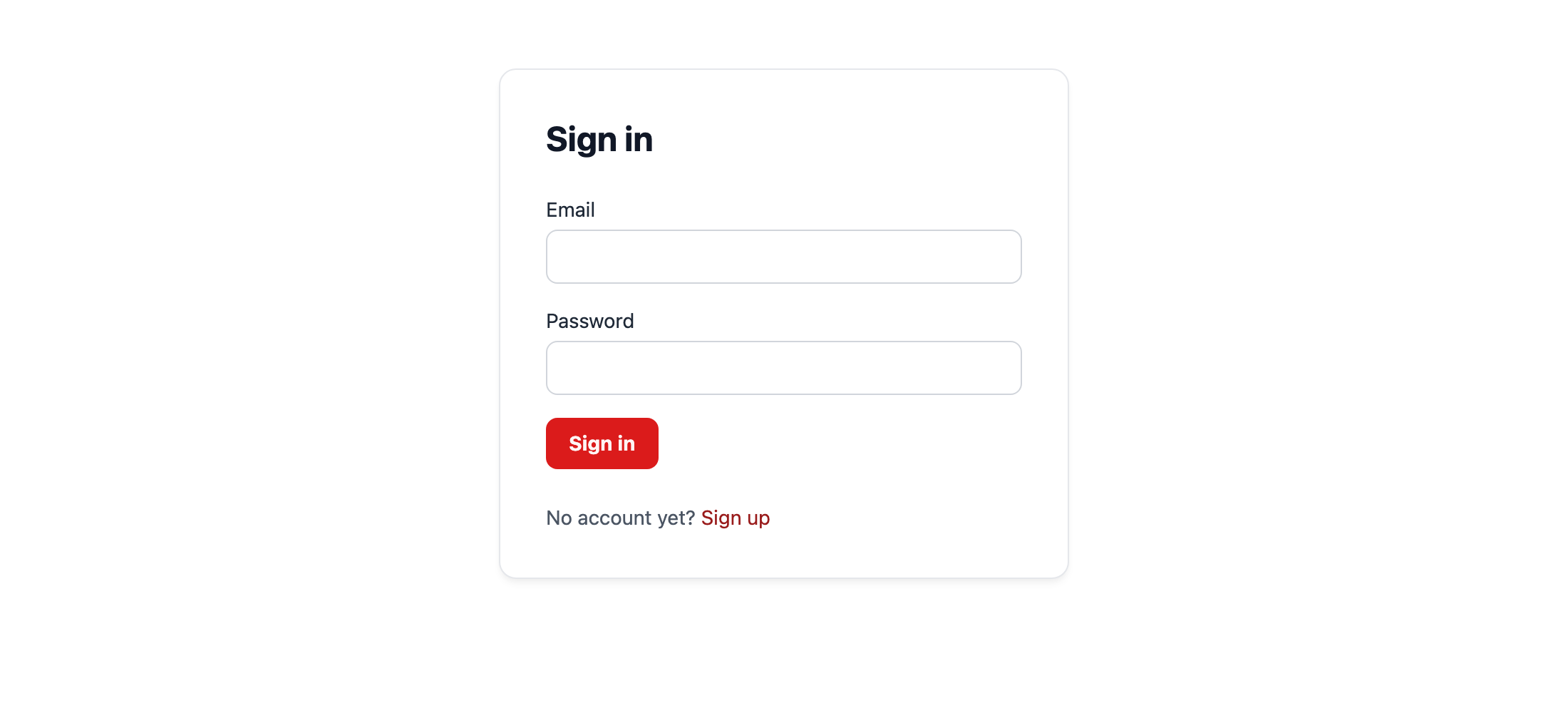
Green. Checkpoint: open http://localhost:3333/register, create an account, and you land on the home page signed in, although nothing on it says so yet. Try /login with the wrong password: "Invalid credentials." Notice the two things you did not build: the session cookie, and the CSRF token the form sent. Both came with auth: {}.
bunx guren gategit add -A
git commit -m "feat: add registration, login, and logout"7. Specify the profile page
Something for a signed-in user to see, and a way out. The specification:
tests/ProfileController.test.tsimport { beforeAll, beforeEach, describe, it } from 'bun:test'
import { TestApp } from '@guren/testing'
import app from '../src/app.js'
import { resetDatabase } from '../config/database.js'
import { User } from '../app/Models/User.js'

describe('ProfileController', () => {
  let http: TestApp

  beforeAll(async () => {
    http = await TestApp.fromApp(app)
  })

  beforeEach(async () => {
    await resetDatabase()
  })

  it('shows the signed-in user their name and email', async () => {
    const user = await User.create({ name: 'Ada', email: 'ada@example.com', password: 'correct horse battery' })

    const response = await http.actingAs(user).get('/profile').assertOk()
    await response.assertBodyContains('ada@example.com')
  })

  it('answers 401 to a guest', async () => {
    await http.get('/profile').assertUnauthorized()
  })
})
bun testTwo red. The second test pins a decision: a guest asking for /profile gets a 401, not a redirect. Chapter 6 turns that into a redirect to the login page for the whole protected area; for one page, the controller can refuse on its own.
8. Delegate it
Ask your agent:
Add a `/profile` page named `profile` for the signed-in user. `ProfileController.show` gets the user with `this.auth.userOrFail()`, which answers 401 to a guest, and sends the name and email to `resources/js/pages/profile/Show.tsx` through a `UserResource` (id, name, email; never the password hash). The page shows both and has a "Log out" button that posts to `/logout` through an Inertia `Link` with `method="post"`. `tests/ProfileController.test.ts` describes it; make it pass.This chapter's harness lever is guren context User. Chapter 1 showed you the whole-project map an agent gets at session start. Before an agent touches one entity, it can ask for that entity's bundle instead:
bunx guren context UserModel, columns, the hidden list, the routes whose actions use the model, the pages those actions render, and the docs that govern it, in one screen. Right now the only such route is POST /register, because RegisterController.store calls User.create(). Login and logout reach the user through this.auth without naming User, so they are not listed; once ProfileController.show exists, its userOrFail<UserRecord>() puts /profile and its page in the bundle. The scaffold's rules tell the agent to run this before entity work, so watch for it in the transcript. An agent that has read the bundle knows passwordHash is hidden and that User is an AuthenticatableModel before it writes the resource.
No agent handy? Four files:
app/Http/Resources/UserResource.tsimport { Resource } from '@guren/core'
import type { UserRecord } from '../../Models/User.js'

export interface UserResourceData extends Record<string, unknown> {
  id: number
  name: string
  email: string
}

export class UserResource extends Resource<UserRecord, UserResourceData> {
  toArray(): UserResourceData {
    return {
      id: this.resource.id,
      name: this.resource.name,
      email: this.resource.email,
    }
  }
}
app/Http/Controllers/ProfileController.tsimport { Controller } from '@guren/core'
import { pages } from '@/.guren/pages.gen'
import type { UserRecord } from '../../Models/User.js'
import { UserResource } from '../Resources/UserResource.js'

export default class ProfileController extends Controller {
  async show(): Promise<Response> {
    const user = await this.auth.userOrFail<UserRecord>()

    return this.inertia(pages.profile.Show, {
      user: new UserResource(user).toJSON(),
    })
  }
}
resources/js/pages/profile/Show.tsximport { Head, Link } from '@inertiajs/react'
import type { UserResourceData } from '@/app/Http/Resources/UserResource'

interface Props {
  user: UserResourceData
}

export default function ProfileShow({ user }: Props) {
  return (
    <>
      <Head title="Your profile" />
      <main className="min-h-screen bg-g-page font-sans text-g-text">
        <div className="mx-auto max-w-3xl space-y-6 px-6 py-12">
          <h1 className="text-3xl font-bold text-g-heading">{user.name}</h1>
          <p className="text-g-text-2">{user.email}</p>
          <Link
            href="/logout"
            method="post"
            as="button"
            className="rounded-g-ctl border border-g-line-strong px-3 py-1 text-sm text-g-text transition hover:border-g-muted"
          >
            Log out
          </Link>
        </div>
      </main>
    </>
  )
}
routes/web.tsimport { Router } from '@guren/core'
import HomeController from '../app/Http/Controllers/HomeController.js'
import AboutController from '../app/Http/Controllers/AboutController.js'
import ContactController from '../app/Http/Controllers/ContactController.js'
import PostController from '../app/Http/Controllers/PostController.js'
import RegisterController from '../app/Http/Controllers/Auth/RegisterController.js'
import LoginController from '../app/Http/Controllers/Auth/LoginController.js'
import ProfileController from '../app/Http/Controllers/ProfileController.js'
import { Post } from '../app/Models/Post.js'
import { PostPayloadSchema } from '../app/Http/Validators/PostValidator.js'
import { RegisterSchema } from '../app/Http/Validators/RegisterValidator.js'
import { LoginSchema } from '../app/Http/Validators/LoginValidator.js'

export function registerWebRoutes(router: Router): void {
  router.get('/', [HomeController, 'index'])
  router.get('/about', [AboutController, 'index']).name('about')
  router.get('/contact', [ContactController, 'index']).name('contact')

  router.get('/register', [RegisterController, 'show']).name('register')
  router.post('/register', { name: 'register.store', body: RegisterSchema }, [RegisterController, 'store'])
  router.get('/login', [LoginController, 'show']).name('login')
  router.post('/login', { name: 'login.store', body: LoginSchema }, [LoginController, 'store'])
  router.post('/logout', [LoginController, 'destroy']).name('logout')
  router.get('/profile', [ProfileController, 'show']).name('profile')

  router.group('/posts', (posts) => {
    posts.get('/', [PostController, 'index']).name('posts.index')
    posts.get('/create', [PostController, 'create']).name('posts.create')
    posts.get('/:id', { bind: { id: Post }, name: 'posts.show' }, [PostController, 'show'])
    posts.get('/:id/edit', { bind: { id: Post }, name: 'posts.edit' }, [PostController, 'edit'])
    posts.post('/', { name: 'posts.store', body: PostPayloadSchema }, [PostController, 'store'])
    posts.put('/:id', { bind: { id: Post }, name: 'posts.update', body: PostPayloadSchema }, [PostController, 'update'])
    posts.delete('/:id', { bind: { id: Post }, name: 'posts.destroy' }, [PostController, 'destroy'])
  })

  // Health check endpoint for load balancers and uptime monitors
  router.get('/health', (c) => c.json({ status: 'ok' }))
}
bun run codegenbun testThe rubric:
- The controller uses
this.auth.userOrFail(), notthis.auth.user()with a manual null check.guren auditrecognises the former as an authentication check; it does not recognise the latter. - The page receives a
UserResource, and the resource has nopasswordHash. Two layers already hide it; the rubric is that the agent did not reach past them. - "Log out" is a
POST, sent through an InertiaLinkso the CSRF token travels with it. A plain<form method="post">would be refused with a 403. - Both tests are green, and every earlier test still is.
Checkpoint: while signed in, open http://localhost:3333/profile, then log out. Reload /profile: a 401.
bunx guren gatebunx guren auditThe audit is quieter than it was. POST /register, /login and /logout are recognised as guest flows and not expected to require authentication. The three warnings on the post routes remain, and chapter 6 clears them.
git add -A
git commit -m "feat: add the profile page"
Where you are
- A
userstable with a hash and a unique email, migrated with a table rebuild. - A model that hashes on create and hides the hash on the way out.
- Sessions with an in-memory store, CSRF protection on every mutating request, and tests that know how to prime a token.
- Registration, login and logout built by hand, with the tests that pin the one property that matters.
- A profile page, specified by you and built by the agent.
Common trip-ups
- Every form test fails with 403 after adding
auth: {}. That is section 4: mutating requests need a CSRF token now. Prime one withwithCsrf()and send through the client it returns. withCsrf()throws "did not set an XSRF-TOKEN cookie".authis not oncreateApp, or the priming path is not served by the app. Pass a path that returns a page.- Registering the same email twice gives a 500. The unique constraint is doing its job and nothing above it is checking first. Chapter 6 adds the check; until then it is a database error, which is still better than two accounts.
this.auththrows "requires the auth middleware".AuthProvideris not inproviders, orauth: {}is missing. Both are needed: one mounts the session, the other names the model.- You were signed in, and then you were not.
bun run devruns the server underbun --hot, and the sessionsauth: {}gives you live in memory, so a hot reload throws them away. Sign in again; this is how it works until chapter 14 moves sessions into the database. actingAs()in a login test always succeeds. It replaces the whole auth context, includingattempt(), with stubs. Use it to be a user, never to test signing in.
Exercises
- Hashing a password is slow on purpose. Time it:
import { Hash } from '@guren/core'

const started = performance.now()
await new Hash().hash('correct horse battery')
console.log(performance.now() - started, 'ms')
Then say why the login route still needs the rate limit chapter 14 adds, even though every attempt costs that much.
2. actingAs() skips the login flow, so it cannot test the flow itself. Write a test that posts the wrong password to /login and asserts the message a visitor sees. Where does that message come from, and why is it the same for a wrong password and an unknown email?
Exercise 1: hint and an example answer
Save the snippet as a file in the app root (for example hash-time.ts), run it with bun hash-time.ts, and delete it afterwards. Do not run it inside bun test: while tests run, the hasher switches to a much cheaper cost so that they stay fast, and the number would mean nothing.
A slow hash limits how fast one attempt is, not how many attempts arrive. An attacker sends many in parallel, from many connections, and each one makes your server spend that time on a hash, so a flood of wrong passwords costs your server far more than it costs the sender. The rate limit in chapter 14 caps the attempts one client can make on /login in a window, which is the one thing the hash cannot do.
Exercise 2: hint and an example answer
tests/LoginController.test.ts from section 5 already has "rejects the wrong password with a message". Read it, then write its twin for an email nobody registered:
it('rejects an unknown email with the same message', async () => {
  const csrf = await http.withCsrf('/login')
  await csrf
    .post('/login', { email: 'nobody@example.com', password: 'correct horse battery' })
    .assertStatus(422)
    .assertJsonPath('errors.message.0', 'Invalid credentials.')
})
The message comes from LoginController.store. When this.auth.attempt() returns false, the action throws ValidationException.withMessages({ message: 'Invalid credentials.' }), and the login page shows it from errors.message. attempt() returns false in both cases without saying which one it was, and the action does not ask. Two different messages would tell anyone with a list of addresses which of them have an account on the blog.
Next
Chapter 6: Protecting Routes puts the post mutations behind a login wall with requireAuthenticated, gives every post an author with a migration that survives real data, and compares what you built with what bunx guren add auth generates.