
Chapter 6: Protecting Routes
The blog has users now, but nothing checks for one: a guest can still write, edit and delete posts, and guren audit has been saying so since chapter 3. This chapter puts the post mutations behind a login wall, gives every post an author with a migration that keeps the rows you already have, and then hands the agent a migration of its own and watches the db-manage skill keep it safe. It ends by showing you what bunx guren add auth would have written, now that you can read it.
Chapter 6: Protecting Routes
The blog has users now, but nothing checks for one: a guest can still write, edit and delete posts, and guren audit has been saying so since chapter 3. This chapter puts the post mutations behind a login wall, gives every post an author with a migration that keeps the rows you already have, and then hands the agent a migration of its own and watches the db-manage skill keep it safe. It ends by showing you what bunx guren add auth would have written, now that you can read it.
What you'll learn:
- What
requireAuthenticatedandrequireGuestdo, and how a middleware alias and a group keep routes readable - Why
guren audittrustsrequireAuthenticatedand not a middleware you wrote with "auth" in its name - How to add a required column to a table that already has rows: nullable, backfill, then not null
- How
setwrites a column the server chooses, whyauthorIdmust never be fillable, and whatforceCreateandforceUpdateare still for - How a skill changes what an agent does with your database
Start the dev server if it is not running:
bun run dev1. Specify the wall
Three test files change, before any route does. Posts first. Every mutating request now happens as Ada, and two new tests say what a guest gets:
tests/PostController.test.tsimport { beforeAll, beforeEach, describe, expect, it } from 'bun:test'
import { TestApp } from '@guren/testing'
import app from '../src/app.js'
import { resetDatabase } from '../config/database.js'
import { Post } from '../app/Models/Post.js'
import { User, type UserRecord } from '../app/Models/User.js'

describe('PostController', () => {
  let http: TestApp
  let ada: UserRecord
  let asAda: TestApp

  beforeAll(async () => {
    http = await TestApp.fromApp(app)
  })

  beforeEach(async () => {
    await resetDatabase()
    ada = await User.create({ name: 'Ada', email: 'ada@example.com', password: 'correct horse battery' })
    asAda = await http.actingAs(ada).withCsrf()
  })

  it('lists posts, newest first', async () => {
    await Post.create({ title: 'First post', body: 'Hello' })
    await Post.create({ title: 'Second post', body: 'Again' })

    const response = await http.get('/posts').assertOk()
    const html = await response.text()
    const first = html.indexOf('First post')
    const second = html.indexOf('Second post')
    if (first === -1 || second === -1 || second > first) {
      throw new Error('expected the newer post to be listed before the older one')
    }
  })

  it('paginates ten posts per page', async () => {
    for (let i = 1; i <= 11; i++) {
      await Post.create({ title: `Post ${String(i).padStart(2, '0')}`, body: `Body number ${i}` })
    }

    const firstPage = await http.get('/posts').assertOk()
    await firstPage.assertBodyContains('Post 11')
    await firstPage.assertBodyContains('Post 02')
    expect(await firstPage.text()).not.toContain('Post 01')

    const secondPage = await http.get('/posts?page=2').assertOk()
    await secondPage.assertBodyContains('Post 01')
    expect(await secondPage.text()).not.toContain('Post 02')
  })

  it('shows one post', async () => {
    const post = await Post.create({ title: 'Read me', body: 'The whole body' })

    const response = await http.get(`/posts/${post.id}`).assertOk()
    await response.assertBodyContains('The whole body')
  })

  it('answers 404 for a post that does not exist', async () => {
    await http.get('/posts/999').assertNotFound()
  })

  it('sends a guest to the login page instead of the form', async () => {
    await http.get('/posts/create').assertRedirect('/login')
  })

  it('sends a guest to the login page instead of storing', async () => {
    const guest = await http.withCsrf()
    await guest.post('/posts', { title: 'Sneaky', body: 'No account' }).assertRedirect('/login')
    expect(await Post.where('title', 'Sneaky').first()).toBeNull()
  })

  it('serves the form for a new post to a signed-in user', async () => {
    await asAda.get('/posts/create').assertOk()
  })

  it('stores a post with the signed-in user as its author and redirects to it', async () => {
    await asAda.post('/posts', { title: 'Written in a test', body: 'By a test' }).assertRedirect()

    const post = await Post.where('title', 'Written in a test').first()
    expect(post).not.toBeNull()
    expect(post?.body).toBe('By a test')
    expect(post?.authorId).toBe(ada.id)
  })

  it('rejects an empty post with a message per field', async () => {
    await asAda
      .post('/posts', { title: '', body: '' })
      .assertStatus(422)
      .assertJsonPath('errors.title.0', 'Title is required')
      .assertJsonPath('errors.body.0', 'Body is required')
  })

  it('serves the edit form with the post in it', async () => {
    const post = await Post.create({ title: 'Before', body: 'The old body' })

    const response = await asAda.get(`/posts/${post.id}/edit`).assertOk()
    await response.assertBodyContains('The old body')
  })

  it('updates a post and redirects to it', async () => {
    const post = await Post.create({ title: 'Before', body: 'The old body' })

    await asAda.put(`/posts/${post.id}`, { title: 'After', body: 'The new body' }).assertRedirect(`/posts/${post.id}`)

    const updated = await Post.findOrFail(post.id)
    expect(updated.title).toBe('After')
    expect(updated.body).toBe('The new body')
  })

  it('rejects an invalid update with the same messages', async () => {
    const post = await Post.create({ title: 'Before', body: 'The old body' })

    await asAda
      .put(`/posts/${post.id}`, { title: '', body: 'Still here' })
      .assertStatus(422)
      .assertJsonPath('errors.title.0', 'Title is required')
  })

  it('deletes a post and redirects to the list', async () => {
    const post = await Post.create({ title: 'Doomed', body: 'Gone soon' })

    await asAda.delete(`/posts/${post.id}`).assertRedirect('/posts')

    expect(await Post.find(post.id)).toBeNull()
  })
})
The profile page stops answering 401 and joins the wall:
tests/ProfileController.test.tsimport { beforeAll, beforeEach, describe, it } from 'bun:test'
import { TestApp } from '@guren/testing'
import app from '../src/app.js'
import { resetDatabase } from '../config/database.js'
import { User } from '../app/Models/User.js'

describe('ProfileController', () => {
  let http: TestApp

  beforeAll(async () => {
    http = await TestApp.fromApp(app)
  })

  beforeEach(async () => {
    await resetDatabase()
  })

  it('shows the signed-in user their name and email', async () => {
    const user = await User.create({ name: 'Ada', email: 'ada@example.com', password: 'correct horse battery' })

    const response = await http.actingAs(user).get('/profile').assertOk()
    await response.assertBodyContains('ada@example.com')
  })

  it('sends a guest to the login page', async () => {
    await http.get('/profile').assertRedirect('/login')
  })
})
And the login page gains the opposite rule, a signed-in user has no business on it:
tests/LoginController.test.tsimport { beforeAll, beforeEach, describe, it } from 'bun:test'
import { TestApp } from '@guren/testing'
import app from '../src/app.js'
import { resetDatabase } from '../config/database.js'
import { User } from '../app/Models/User.js'

describe('LoginController', () => {
  let http: TestApp

  beforeAll(async () => {
    http = await TestApp.fromApp(app)
  })

  beforeEach(async () => {
    await resetDatabase()
    await User.create({ name: 'Ada', email: 'ada@example.com', password: 'correct horse battery' })
  })

  it('serves the login form', async () => {
    await http.get('/login').assertOk()
  })

  it('sends a signed-in user home instead of the login form', async () => {
    const user = await User.where('email', 'ada@example.com').first()
    await http.actingAs(user).get('/login').assertRedirect('/')
  })

  it('signs in with the right password and redirects', async () => {
    const csrf = await http.withCsrf('/login')
    await csrf.post('/login', { email: 'ada@example.com', password: 'correct horse battery' }).assertRedirect('/')
  })

  it('rejects the wrong password with a message', async () => {
    const csrf = await http.withCsrf('/login')
    await csrf
      .post('/login', { email: 'ada@example.com', password: 'wrong' })
      .assertStatus(422)
      .assertJsonPath('errors.message.0', 'Invalid credentials.')
  })

  it('signs out and redirects home', async () => {
    const user = await User.where('email', 'ada@example.com').first()
    const csrf = await http.actingAs(user).withCsrf()
    await csrf.post('/logout').assertRedirect('/')
  })
})
bun testFive red: the guest redirects, the signed-in redirect from /login, and the author on a stored post, which does not exist yet. Note the shape of the guest test for POST /posts: it primes a CSRF token like any other, because CSRF is checked before authentication, and then asserts that nothing was stored. A redirect alone would not prove the wall held.
2. Two aliases, two groups
Replace routes/web.ts:
routes/web.tsimport { Router, requireAuthenticated, requireGuest } from '@guren/core'
import HomeController from '../app/Http/Controllers/HomeController.js'
import AboutController from '../app/Http/Controllers/AboutController.js'
import ContactController from '../app/Http/Controllers/ContactController.js'
import PostController from '../app/Http/Controllers/PostController.js'
import RegisterController from '../app/Http/Controllers/Auth/RegisterController.js'
import LoginController from '../app/Http/Controllers/Auth/LoginController.js'
import ProfileController from '../app/Http/Controllers/ProfileController.js'
import { Post } from '../app/Models/Post.js'
import { PostPayloadSchema } from '../app/Http/Validators/PostValidator.js'
import { RegisterSchema } from '../app/Http/Validators/RegisterValidator.js'
import { LoginSchema } from '../app/Http/Validators/LoginValidator.js'

export function registerWebRoutes(baseRouter: Router): void {
  // aliasMiddleware() returns a Router carrying the alias name in its type;
  // capture it, or `.middleware('auth')` below will not compile.
  const router = baseRouter
    .aliasMiddleware('auth', requireAuthenticated({ redirectTo: '/login' }))
    .aliasMiddleware('guest', requireGuest({ redirectTo: '/' }))

  router.get('/', [HomeController, 'index'])
  router.get('/about', [AboutController, 'index']).name('about')
  router.get('/contact', [ContactController, 'index']).name('contact')

  router.middleware('guest').group((guest) => {
    guest.get('/register', [RegisterController, 'show']).name('register')
    guest.post('/register', { name: 'register.store', body: RegisterSchema }, [RegisterController, 'store'])
    guest.get('/login', [LoginController, 'show']).name('login')
    guest.post('/login', { name: 'login.store', body: LoginSchema }, [LoginController, 'store'])
  })

  router.middleware('auth').group((auth) => {
    auth.post('/logout', [LoginController, 'destroy']).name('logout')
    auth.get('/profile', [ProfileController, 'show']).name('profile')
    auth.get('/posts/create', [PostController, 'create']).name('posts.create')
    auth.get('/posts/:id/edit', { bind: { id: Post }, name: 'posts.edit' }, [PostController, 'edit'])
    auth.post('/posts', { name: 'posts.store', body: PostPayloadSchema }, [PostController, 'store'])
    auth.put('/posts/:id', { bind: { id: Post }, name: 'posts.update', body: PostPayloadSchema }, [PostController, 'update'])
    auth.delete('/posts/:id', { bind: { id: Post }, name: 'posts.destroy' }, [PostController, 'destroy'])
  })

  router.get('/posts', [PostController, 'index']).name('posts.index')
  router.get('/posts/:id', { bind: { id: Post }, name: 'posts.show' }, [PostController, 'show'])

  // Health check endpoint for load balancers and uptime monitors
  router.get('/health', (c) => c.json({ status: 'ok' }))
}
requireAuthenticated({ redirectTo: '/login' })asks the guard whether the session has a user and redirects if not. WithoutredirectToit answers a 401, which is what an API wants and what chapter 5's profile page did.requireGuest({ redirectTo: '/' })is the mirror image, for pages that only make sense signed out.aliasMiddlewaregives each a name;router.middleware('auth').group(...)applies it to everything inside. Read the file top to bottom and you can see the wall: public, guest-only, signed-in-only, public again. The one rule the order has to respect is unchanged from chapter 3:/posts/createbefore/posts/:id.
Now the author. Replace the schema first: authorId references users, and it is nullable for now, on purpose:
db/schema.tsimport { sqliteTable, integer, text } from '@guren/orm/drizzle/sqlite'

export const users = sqliteTable('users', {
  id: integer('id').primaryKey({ autoIncrement: true }),
  name: text('name').notNull(),
  email: text('email').notNull().unique(),
  passwordHash: text('password_hash').notNull(),
  rememberToken: text('remember_token'),
  createdAt: text('created_at').notNull().$defaultFn(() => new Date().toISOString()),
})

export const posts = sqliteTable('posts', {
  id: integer('id').primaryKey({ autoIncrement: true }),
  title: text('title').notNull(),
  body: text('body').notNull(),
  authorId: integer('author_id').references(() => users.id),
  createdAt: text('created_at').notNull().$defaultFn(() => new Date().toISOString()),
})
bun run db:make add_author_to_postsbun run db:migrateThen store records who wrote the post:
app/Http/Controllers/PostController.tsimport { Controller, paginate, type PaginatedPageProps } from '@guren/core'
import { pages } from '@/.guren/pages.gen'
import { Post } from '../../Models/Post.js'
import type { UserRecord } from '../../Models/User.js'
import { PostResource, type PostResourceData } from '../Resources/PostResource.js'
import { ListPostsQuerySchema, PostPayloadSchema } from '../Validators/PostValidator.js'

type PostsIndexProps = PaginatedPageProps<PostResourceData>

export default class PostController extends Controller {
  async index(): Promise<Response> {
    const { page } = this.validateQuery(ListPostsQuerySchema)
    const result = await Post.paginate({ page, perPage: 10, orderBy: ['id', 'desc'] })
    const paginator = paginate(result, { path: this.request.path ?? '/posts' })

    return this.inertia(pages.posts.Index, {
      data: result.data.map((post) => new PostResource(post).toJSON()),
      pagination: {
        meta: paginator.meta(),
        links: paginator.links(),
      },
    } satisfies PostsIndexProps)
  }

  async show(): Promise<Response> {
    const post = this.model(Post)

    return this.inertia(pages.posts.Show, {
      post: new PostResource(post).toJSON(),
    })
  }

  async create(): Promise<Response> {
    return this.inertia(pages.posts.New, {})
  }

  async store(): Promise<Response> {
    const author = await this.auth.userOrFail<UserRecord>()
    const data = await this.validateBody(PostPayloadSchema)
    const post = await Post.create(data, { set: { authorId: author.id } })
    return this.redirect(`/posts/${post.id}`)
  }

  async edit(): Promise<Response> {
    const post = this.model(Post)

    return this.inertia(pages.posts.Edit, {
      post: new PostResource(post).toJSON(),
    })
  }

  async update(): Promise<Response> {
    const post = this.model(Post)
    const data = await this.validateBody(PostPayloadSchema)
    await Post.update({ id: post.id }, data)
    return this.redirect(`/posts/${post.id}`)
  }

  async destroy(): Promise<Response> {
    const post = this.model(Post)
    await Post.delete({ id: post.id })
    return this.redirect('/posts')
  }
}
The second argument to create is worth a moment. fillable on the model lists title and body, and authorId is not on it: a request must never be able to say who wrote a post. Post.create({ ...data, authorId: author.id }) would therefore throw a MassAssignmentException naming authorId. set holds the columns the server chose. data still goes through fillable, and authorId is written beside it from the session. set throws on a key that is in fillable or that data also carries, so if the validator ever gains an authorId field, the request still cannot choose the author: the write fails instead.
forceCreate would also write this row, but it skips fillable for the whole object, the request data included. Keep force writes for writes that carry no request data at all, like the backfill script in the next section and the rows your tests create.
bun testGreen. Now look at the audit:
bunx guren auditThe three authentication warnings are gone. The report prints only what still needs attention, so to see what replaced them run bunx guren audit --json: each of those routes now passes with "Protected by an authentication guard (verified via middleware capabilities)". That last phrase matters. requireAuthenticated carries a marker the framework stamps on it; audit trusts the marker, not the name. Had you written your own requireLogin middleware and aliased it as auth, the audit would say the middleware is named like a guard but is not one it recognises, and keep warning. That is the right answer: a reviewer, human or machine, cannot tell from a name whether a function checks anything.
store gets no warning about how it writes, either. A method that validates a body and then calls forceCreate or forceUpdate gets [warn] [API3] ... force write, because audit cannot follow the data to see whether the request reached the force write. With set, the request data never leaves fillable, so there is nothing for that warning to ask. If you meet it in another codebase, treat it as a review prompt: read what reaches the force write before you decide.
bunx guren gategit add -A
git commit -m "feat: protect post mutations and record each post's author"3. The rows you already have
authorId is nullable, and your development database has posts from chapters 3 and 4 with no author. Making the column required now would fail on those rows, and the old way around that, dropping the database and starting over, throws away data, which is not something you get to do once an app is deployed. The migration that survives real data is three steps: add the column nullable (done), fill it in, then require it.
The backfill is a script, not a migration, because it makes a decision a migration should not make on its own: which user owns the orphaned posts. Here, a "Legacy author" account that nobody can sign in to:
scripts/backfill-post-authors.tsimport app from '../src/app.js'
import { Post } from '../app/Models/Post.js'
import { User } from '../app/Models/User.js'

await app.boot()

const orphans = (await Post.all()).filter((post) => post.authorId === null)
if (orphans.length === 0) {
  console.log('Every post has an author; nothing to do.')
  process.exit(0)
}

const legacy =
  (await User.where('email', 'legacy@guren-blog.test').first()) ??
  (await User.create({ name: 'Legacy author', email: 'legacy@guren-blog.test', password: crypto.randomUUID() }))

for (const post of orphans) {
  await Post.forceUpdate({ id: post.id }, { authorId: legacy.id })
}

console.log(`Assigned ${orphans.length} post(s) to ${legacy.name} (#${legacy.id}).`)
bun scripts/backfill-post-authors.tsforceUpdate is right here: the script carries no request data at all, and authorId is not fillable. A random UUID as the password means the account has a valid hash and no password anyone knows.
Requiring the column is the next slice, and it is the agent's.
4. Specify the constraint and the names
Two things the reader of the blog cannot yet see: that every post has an author, and who it is. Replace the posts test file. Every post created in a test now names its author, and three tests are new: the schema declares authorId as not null, and the list and the page show the author's name.
tests/PostController.test.tsimport { beforeAll, beforeEach, describe, expect, it } from 'bun:test'
import { TestApp } from '@guren/testing'
import app from '../src/app.js'
import { resetDatabase } from '../config/database.js'
import { posts } from '../db/schema.js'
import { Post } from '../app/Models/Post.js'
import { User, type UserRecord } from '../app/Models/User.js'

describe('PostController', () => {
  let http: TestApp
  let ada: UserRecord
  let asAda: TestApp

  beforeAll(async () => {
    http = await TestApp.fromApp(app)
  })

  beforeEach(async () => {
    await resetDatabase()
    ada = await User.create({ name: 'Ada', email: 'ada@example.com', password: 'correct horse battery' })
    asAda = await http.actingAs(ada).withCsrf()
  })

  it('requires an author at the schema level', () => {
    expect(posts.authorId.notNull).toBe(true)
  })

  it('lists posts, newest first, each with its author', async () => {
    const grace = await User.create({ name: 'Grace', email: 'grace@example.com', password: 'correct horse battery' })
    await Post.forceCreate({ title: 'First post', body: 'Hello', authorId: ada.id })
    await Post.forceCreate({ title: 'Second post', body: 'Again', authorId: grace.id })

    const response = await http.get('/posts').assertOk()
    const html = await response.text()
    const first = html.indexOf('First post')
    const second = html.indexOf('Second post')
    if (first === -1 || second === -1 || second > first) {
      throw new Error('expected the newer post to be listed before the older one')
    }
    await response.assertBodyContains('Ada')
    await response.assertBodyContains('Grace')
  })

  it('paginates ten posts per page', async () => {
    for (let i = 1; i <= 11; i++) {
      await Post.forceCreate({ title: `Post ${String(i).padStart(2, '0')}`, body: `Body number ${i}`, authorId: ada.id })
    }

    const firstPage = await http.get('/posts').assertOk()
    await firstPage.assertBodyContains('Post 11')
    await firstPage.assertBodyContains('Post 02')
    expect(await firstPage.text()).not.toContain('Post 01')

    const secondPage = await http.get('/posts?page=2').assertOk()
    await secondPage.assertBodyContains('Post 01')
    expect(await secondPage.text()).not.toContain('Post 02')
  })

  it('shows one post with its author', async () => {
    const post = await Post.forceCreate({ title: 'Read me', body: 'The whole body', authorId: ada.id })

    const response = await http.get(`/posts/${post.id}`).assertOk()
    await response.assertBodyContains('The whole body')
    await response.assertBodyContains('Ada')
  })

  it('answers 404 for a post that does not exist', async () => {
    await http.get('/posts/999').assertNotFound()
  })

  it('sends a guest to the login page instead of the form', async () => {
    await http.get('/posts/create').assertRedirect('/login')
  })

  it('sends a guest to the login page instead of storing', async () => {
    const guest = await http.withCsrf()
    await guest.post('/posts', { title: 'Sneaky', body: 'No account' }).assertRedirect('/login')
    expect(await Post.where('title', 'Sneaky').first()).toBeNull()
  })

  it('serves the form for a new post to a signed-in user', async () => {
    await asAda.get('/posts/create').assertOk()
  })

  it('stores a post with the signed-in user as its author and redirects to it', async () => {
    await asAda.post('/posts', { title: 'Written in a test', body: 'By a test' }).assertRedirect()

    const post = await Post.where('title', 'Written in a test').first()
    expect(post).not.toBeNull()
    expect(post?.body).toBe('By a test')
    expect(post?.authorId).toBe(ada.id)
  })

  it('rejects an empty post with a message per field', async () => {
    await asAda
      .post('/posts', { title: '', body: '' })
      .assertStatus(422)
      .assertJsonPath('errors.title.0', 'Title is required')
      .assertJsonPath('errors.body.0', 'Body is required')
  })

  it('serves the edit form with the post in it', async () => {
    const post = await Post.forceCreate({ title: 'Before', body: 'The old body', authorId: ada.id })

    const response = await asAda.get(`/posts/${post.id}/edit`).assertOk()
    await response.assertBodyContains('The old body')
  })

  it('updates a post and redirects to it', async () => {
    const post = await Post.forceCreate({ title: 'Before', body: 'The old body', authorId: ada.id })

    await asAda.put(`/posts/${post.id}`, { title: 'After', body: 'The new body' }).assertRedirect(`/posts/${post.id}`)

    const updated = await Post.findOrFail(post.id)
    expect(updated.title).toBe('After')
    expect(updated.body).toBe('The new body')
  })

  it('rejects an invalid update with the same messages', async () => {
    const post = await Post.forceCreate({ title: 'Before', body: 'The old body', authorId: ada.id })

    await asAda
      .put(`/posts/${post.id}`, { title: '', body: 'Still here' })
      .assertStatus(422)
      .assertJsonPath('errors.title.0', 'Title is required')
  })

  it('deletes a post and redirects to the list', async () => {
    const post = await Post.forceCreate({ title: 'Doomed', body: 'Gone soon', authorId: ada.id })

    await asAda.delete(`/posts/${post.id}`).assertRedirect('/posts')

    expect(await Post.find(post.id)).toBeNull()
  })
})
bun testThree red. The first of them, posts.authorId.notNull, is a test of the schema itself: Drizzle's column objects know their own constraints, so the decision "a post has an author" can be pinned without a database.
5. Delegate it
Ask your agent:
Every post now has an author (`scripts/backfill-post-authors.ts` has run). Make `authorId` on the `posts` table NOT NULL with a new migration, and show each post's author name on the posts list and the post page. Load the authors for a page of posts in one query, not one per post, and keep `PostResource` the one place a post's shape is defined. `tests/PostController.test.ts` describes all of it; make it pass.This is the first time the agent touches your database, and this chapter's harness lever is the db-manage skill in .claude/skills/db-manage/. Read it before the agent does. It tells the agent how migrations are generated, applied and inspected in this app (make:migration, db:migrate, db:status), that they are forward-only, and it carries safety rules: a destructive operation (db:reset, db:fresh) is never run without confirming with you first, showing what it would affect and warning about the data loss. Watch whether the agent generates a migration and applies it, or asks you about a reset. The skill exists so that the difference is not left to the model's mood.
No agent handy? The schema gains one word, then the migration, then the code:
db/schema.tsimport { sqliteTable, integer, text } from '@guren/orm/drizzle/sqlite'

export const users = sqliteTable('users', {
  id: integer('id').primaryKey({ autoIncrement: true }),
  name: text('name').notNull(),
  email: text('email').notNull().unique(),
  passwordHash: text('password_hash').notNull(),
  rememberToken: text('remember_token'),
  createdAt: text('created_at').notNull().$defaultFn(() => new Date().toISOString()),
})

export const posts = sqliteTable('posts', {
  id: integer('id').primaryKey({ autoIncrement: true }),
  title: text('title').notNull(),
  body: text('body').notNull(),
  authorId: integer('author_id').notNull().references(() => users.id),
  createdAt: text('created_at').notNull().$defaultFn(() => new Date().toISOString()),
})
bun run db:make require_post_authorsbun run db:migrateThe resource learns about authors. It takes a post that may carry its author record, and sends only the author's id and name:
app/Http/Resources/PostResource.tsimport { Resource } from '@guren/core'
import type { PostRecord } from '../../Models/Post.js'
import type { UserRecord } from '../../Models/User.js'

export type PostWithAuthor = PostRecord & { author?: UserRecord | null }

export interface PostResourceData extends Record<string, unknown> {
  id: number
  title: string
  body: string
  createdAt: string
  author: { id: number; name: string } | null
}

export class PostResource extends Resource<PostWithAuthor, PostResourceData> {
  toArray(): PostResourceData {
    const author = this.resource.author
    return {
      id: this.resource.id,
      title: this.resource.title,
      body: this.resource.body,
      createdAt: this.resource.createdAt,
      author: author ? { id: author.id, name: author.name } : null,
    }
  }
}
app/Http/Controllers/PostController.tsimport { Controller, paginate, type PaginatedPageProps } from '@guren/core'
import { pages } from '@/.guren/pages.gen'
import { Post, type PostRecord } from '../../Models/Post.js'
import { User, type UserRecord } from '../../Models/User.js'
import { PostResource, type PostResourceData } from '../Resources/PostResource.js'
import { ListPostsQuerySchema, PostPayloadSchema } from '../Validators/PostValidator.js'

type PostsIndexProps = PaginatedPageProps<PostResourceData>

async function authorsOf(posts: PostRecord[]): Promise<Map<number, UserRecord>> {
  const ids = [...new Set(posts.map((post) => post.authorId))]
  const authors = ids.length === 0 ? [] : await User.where({ id: ids }).get()
  return new Map(authors.map((author) => [author.id, author]))
}

export default class PostController extends Controller {
  async index(): Promise<Response> {
    const { page } = this.validateQuery(ListPostsQuerySchema)
    const result = await Post.paginate({ page, perPage: 10, orderBy: ['id', 'desc'] })
    const paginator = paginate(result, { path: this.request.path ?? '/posts' })
    const authors = await authorsOf(result.data)

    return this.inertia(pages.posts.Index, {
      data: result.data.map((post) => new PostResource({ ...post, author: authors.get(post.authorId) ?? null }).toJSON()),
      pagination: {
        meta: paginator.meta(),
        links: paginator.links(),
      },
    } satisfies PostsIndexProps)
  }

  async show(): Promise<Response> {
    const post = this.model(Post)
    const author = await User.find(post.authorId)

    return this.inertia(pages.posts.Show, {
      post: new PostResource({ ...post, author }).toJSON(),
    })
  }

  async create(): Promise<Response> {
    return this.inertia(pages.posts.New, {})
  }

  async store(): Promise<Response> {
    const author = await this.auth.userOrFail<UserRecord>()
    const data = await this.validateBody(PostPayloadSchema)
    const post = await Post.create(data, { set: { authorId: author.id } })
    return this.redirect(`/posts/${post.id}`)
  }

  async edit(): Promise<Response> {
    const post = this.model(Post)

    return this.inertia(pages.posts.Edit, {
      post: new PostResource(post).toJSON(),
    })
  }

  async update(): Promise<Response> {
    const post = this.model(Post)
    const data = await this.validateBody(PostPayloadSchema)
    await Post.update({ id: post.id }, data)
    return this.redirect(`/posts/${post.id}`)
  }

  async destroy(): Promise<Response> {
    const post = this.model(Post)
    await Post.delete({ id: post.id })
    return this.redirect('/posts')
  }
}
User.where({ id: ids }) with an array is an IN query: one round trip for a whole page of posts, however many authors it has. Chapter 9 replaces authorsOf with a relationship and with('author'), which does the same thing with less code; the query it runs is this one.
The two pages render the name:
resources/js/pages/posts/Index.tsximport { Head, Link } from '@inertiajs/react'
import type { PaginatedPageProps } from '@guren/core'
import type { PostResourceData } from '@/app/Http/Resources/PostResource'
import { route } from '@/.guren/routes.gen'

interface Props extends PaginatedPageProps<PostResourceData> {}

export default function PostsIndex({ data, pagination }: Props) {
  return (
    <>
      <Head title="Posts" />
      <main className="min-h-screen bg-g-page font-sans text-g-text">
        <div className="mx-auto max-w-3xl space-y-6 px-6 py-12">
          <div className="flex items-center justify-between">
            <h1 className="flex items-center gap-3 text-3xl font-bold text-g-heading">
              <span aria-hidden className="h-7 w-[3px] shrink-0 rounded-full bg-[image:var(--g-tick)]" />
              Posts
            </h1>
            <Link href={route('posts.create')} className="rounded-g-ctl bg-g-accent px-4 py-2 text-sm font-bold text-g-on-accent transition hover:bg-g-accent-down">
              New post
            </Link>
          </div>
          {data.length === 0 && <p className="text-g-text-2">No posts yet.</p>}
          <div className="space-y-4">
            {data.map((post) => (
              <article key={post.id} className="rounded-g-card border border-g-line bg-g-panel p-4 shadow-g-card">
                <Link href={route('posts.show', { id: post.id })} className="text-xl font-bold text-g-heading transition hover:text-g-accent-text">
                  {post.title}
                </Link>
                <p className="mt-1 font-mono text-xs text-g-text-2">by {post.author?.name ?? 'unknown'}</p>
                <p className="mt-2 text-sm text-g-text-2">{post.body}</p>
              </article>
            ))}
          </div>
          {pagination?.links?.pages && pagination.links.pages.length > 1 && (
            <nav className="flex gap-2 font-mono text-sm">
              {pagination.links.pages.map((page) => (
                <Link key={page.page} href={page.url ?? '#'} className="rounded-g-ctl border border-g-line px-3 py-1 text-g-text-2 transition hover:border-g-line-strong hover:text-g-heading">
                  {page.page}
                </Link>
              ))}
            </nav>
          )}
        </div>
      </main>
    </>
  )
}
resources/js/pages/posts/Show.tsximport { Head, Link } from '@inertiajs/react'
import type { PostResourceData } from '@/app/Http/Resources/PostResource'
import { route } from '@/.guren/routes.gen'

interface Props {
  post: PostResourceData
}

export default function PostShow({ post }: Props) {
  return (
    <>
      <Head title={post.title} />
      <main className="min-h-screen bg-g-page font-sans text-g-text">
        <div className="mx-auto max-w-3xl space-y-6 px-6 py-12">
          <Link href={route('posts.index')} className="text-sm text-g-accent-text transition hover:underline">
            All posts
          </Link>
          <h1 className="text-3xl font-bold text-g-heading">{post.title}</h1>
          <p className="font-mono text-xs text-g-text-2">
            by {post.author?.name ?? 'unknown'} · {post.createdAt}
          </p>
          <p className="whitespace-pre-wrap text-lg">{post.body}</p>
          <div className="flex items-center gap-4">
            <Link href={route('posts.edit', { id: post.id })} className="text-g-accent-text transition hover:underline">
              Edit
            </Link>
            <Link
              href={route('posts.destroy', { id: post.id })}
              method="delete"
              as="button"
              onBefore={() => window.confirm('Delete this post?')}
              className="rounded-g-ctl border border-g-danger-chip px-3 py-1 text-sm font-bold text-g-danger transition hover:bg-g-danger-tint"
            >
              Delete
            </Link>
          </div>
        </div>
      </main>
    </>
  )
}
bun run codegenbun testThe rubric:
- A new migration folder exists under
db/migrations/, andbun run db:statusshows it applied. There is nodb:resetordb:freshin the transcript; if the agent proposed one, it asked you first, which is the skill doing its job, and the answer was no. authorIdisnotNull()in the schema and still not infillable.- The list loads its authors with one
INquery, not aUser.findinside the map. PostResourceis still the only place a post's shape is written, and the author it emits is an id and a name, not a user record.- All fourteen tests are green.
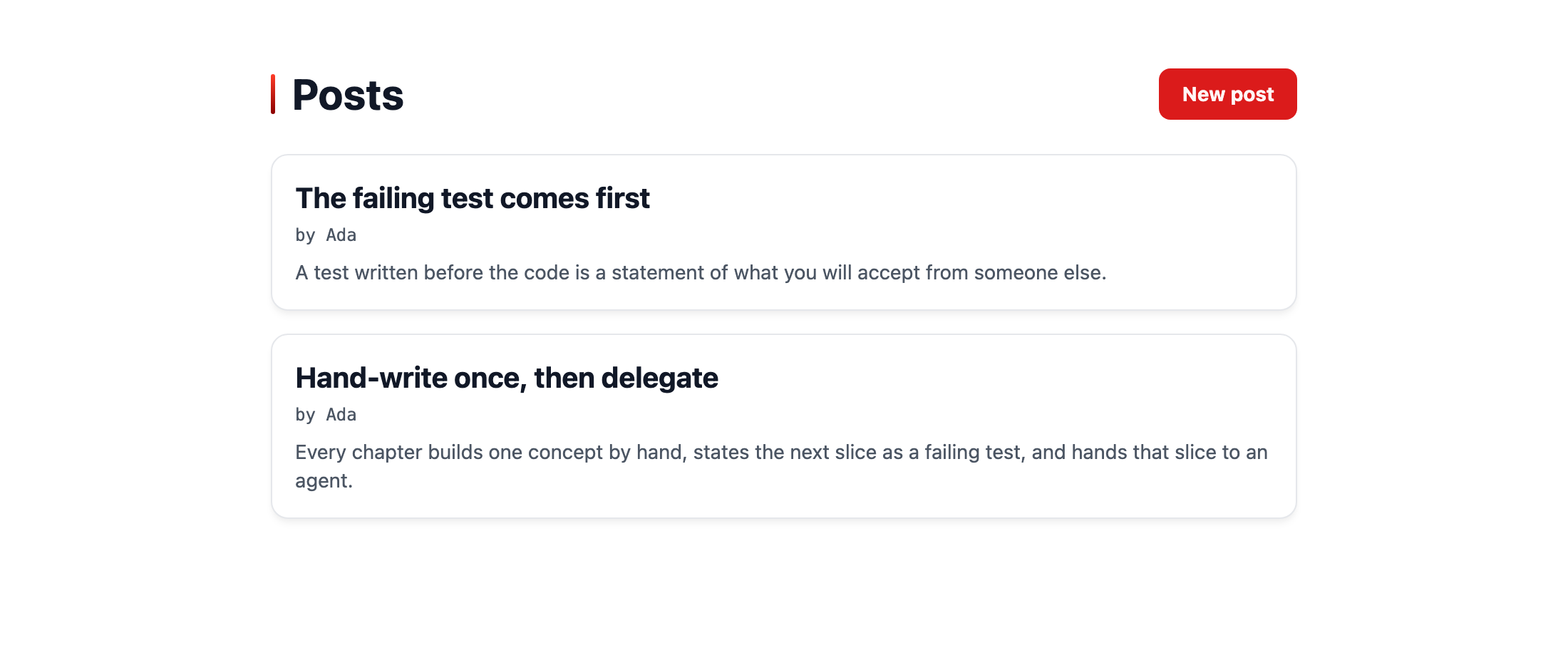
Checkpoint: the posts list at http://localhost:3333/posts shows "by Legacy author" on the posts you wrote before this chapter, and your name on any you write now.
bunx guren gategit add -A
git commit -m "feat: require an author on every post and show it"What add auth would have given you
You now know what a session, a guard, a hash, a CSRF token and a login wall are, because you built each one. That is the moment to look at the generator. Stop bun run dev first (Ctrl-C in its terminal), then work on a branch you will throw away:
git switch -c scratch/add-auth
bunx guren add auth --force
git status --short
git switch main
git reset --hard
git clean -fdn
git clean -fd
git branch -D scratch/add-auth
bun run db:status
Stopping the server comes first because add auth edits src/app.ts, and a running dev server reloads on that edit. The reload boots the app, which applies the migration add auth has just written and runs its demo-user seeder, all before you have read the diff. No git command takes that back out of the database.
The reset and the clean are not tidiness either. git switch main and git branch -D move a reference, and neither undoes work you never committed. Without them, everything add auth wrote is still in your working tree on main, a migration folder under db/migrations/ included, and the next boot applies it. Eight chapters from here, chapter 14 creates the sessions table itself, and its migration fails on a table that is already there.
One file survives git clean on purpose: .env is ignored, and add auth appended two blocks to its end: one that starts with a comment about the mail transport and sets MAIL_MAILER and the SMTP_* keys, and one that starts with a comment about config/session.ts and sets SESSION_DRIVER. Delete both. db:status should then list every migration as applied and none as orphaned. If one is orphaned, the server reloaded before you stopped it; bun run db:reset rebuilds the database from the migrations you have and drops every row with it. Start bun run dev again.
git status rather than git diff: add auth creates files as well as changing them, and a diff against main leaves the new, untracked ones out. Most of that list is what you wrote, in the same shape: the model, the provider, the two controllers, the validators. The rest is what you did not: forgot-password and reset-password pages with the email that links them, a "remember me" token, a seeder with a demo user, a dashboard. Email verification is not in it; bunx guren make:auth --verify is the generator that adds it. From now on, when the course needs one of those, you will reach for the generator, and you will be able to read what it wrote.
Where you are
- Post mutations, the profile and logout behind
requireAuthenticated; the login and registration pages behindrequireGuest. - An audit you can read: the authentication warnings answered, the author written through
setrather than a force write, and an understanding of why the audit trusts the framework's guard and not a name. - An author on every post, added without losing a row: nullable, backfilled, required.
- The agent's first migration, run under the
db-manageskill's rules.
Common trip-ups
.middleware('auth')does not compile.aliasMiddleware()returns a new router type that knows the name; the result was not captured. Chain and assign, as in the file above.- A signed-in test gets redirected to
/login.actingAs()must come beforewithCsrf(): the priming request has to be authenticated too. Both return new clients; reassign. db:migratefails with "NOT NULL constraint failed". A post still has no author; runbun scripts/backfill-post-authors.tsfirst. The order is the whole point of section 3.storeanswers 500 with aMassAssignmentExceptionnamingauthorId. EitherauthorIdarrived indata(spread into the first argument, or admitted by the validator), or it is listed infillable.setrefuses both: keepauthorIdout offillableand out ofPostPayloadSchema, and pass it only inset.- The list shows "unknown" for every author. The
INquery got ids of the wrong type, or the map is keyed by something other than the user's id. Logauthorsonce; it should have one entry per distinct author.
Exercises
- A guest who opens
/posts/createis redirected to/login. What happens to a guest who POSTs to/posts? Write the test and find out before you guess; then say whether that answer is the one you want. - The backfill script filled
authorIdon rows that had none. On a branch, make the column nullable again and runbun run db:makewithout applying it. Read the SQL. Why does SQLite rebuild the table instead of altering the column? Undo it withgit reset --hardandgit clean -fd, not withgit branch -Dalone.
Exercise 1: hint and an example answer
Section 1's tests/PostController.test.ts already has "sends a guest to the login page instead of storing". Read it beside requireAuthenticated({ redirectTo: '/login' }) in routes/web.ts.
The guest gets the same redirect to /login as for the form, and nothing is stored: the middleware answers before the action runs, whatever the method. CSRF runs before authentication, so a guest POST without a token is refused with a 403 before it even reaches the wall; that is why the test primes a token with withCsrf(). Whether the redirect is what you want depends on who is calling. For a person in a browser it is reasonable, although the form they filled in is lost and LoginController always sends them to / afterwards. A JSON client would rather get a 401, which is what requireAuthenticated() answers without redirectTo. Other answers are possible.
Exercise 2: hint and an example answer
Compare the SQL with what chapter 5 section 1 said about the users migration, and ask what SQLite's ALTER TABLE can change.
The SQL rebuilds posts. It turns foreign-key enforcement off, creates __new_posts with author_id nullable, copies every row across with INSERT … SELECT, drops posts, renames __new_posts to posts, and turns foreign keys back on. The two pragma lines do nothing inside the migrator's transaction; createSqliteDatabase() turns enforcement off around the whole run instead. SQLite's ALTER TABLE can rename a table and add, rename or drop a column, but it cannot change the definition of a column that exists, and NOT NULL is part of that definition. The only way to change it is to build the table again in the new shape and copy the rows, and the copy is why no row is lost. Postgres, where chapter 14 takes the app, changes it in place with ALTER COLUMN … DROP NOT NULL.
Next
Chapter 7: Authorization, and What the Gate Cannot See makes editing and deleting an author-only affair with a policy, then asks the agent for a feature without mentioning authorization, and shows you which of your safeguards notices.