
紅蓮gu·ren, crimson lotus
The Bun-first fullstack TypeScript framework.
Laravel-style conventions, types from the route to the React component, and checks your coding agent runs on its own work. Develop on Bun, deploy to Bun, AWS Lambda, Vercel or Cloudflare Workers.
Route to React, one loop
A route points at a controller, and the controller's props reach the React component type-checked. There is no API client to write.
routes/web.ts
import { Router, requireAuthenticated } from '@guren/core'

export function registerWebRoutes(base: Router) {
  const router = base.aliasMiddleware(
    'auth',
    requireAuthenticated({ redirectTo: '/login' }),
  )

  router.get('/posts', [PostController, 'index']).name('posts.index')
  router.get('/posts/:id', [PostController, 'show']).name('posts.show')

  router.middleware('auth').group((auth) => {
    auth.post('/posts', [PostController, 'store']).name('posts.store')
  })
}
Built for AI coding agents
derived where possible, declared where not, checked always
Your agent reads what the project knows from the code itself, and CI fails when the wiring, docs or spec drift.
- $ guren context User
- Everything about one entity
- $ guren spec:generate
- ER, domain and screen views from code
- $ guren check
- Wiring, doc links, spec drift
- $ guren audit
- Validation, auth, secrets
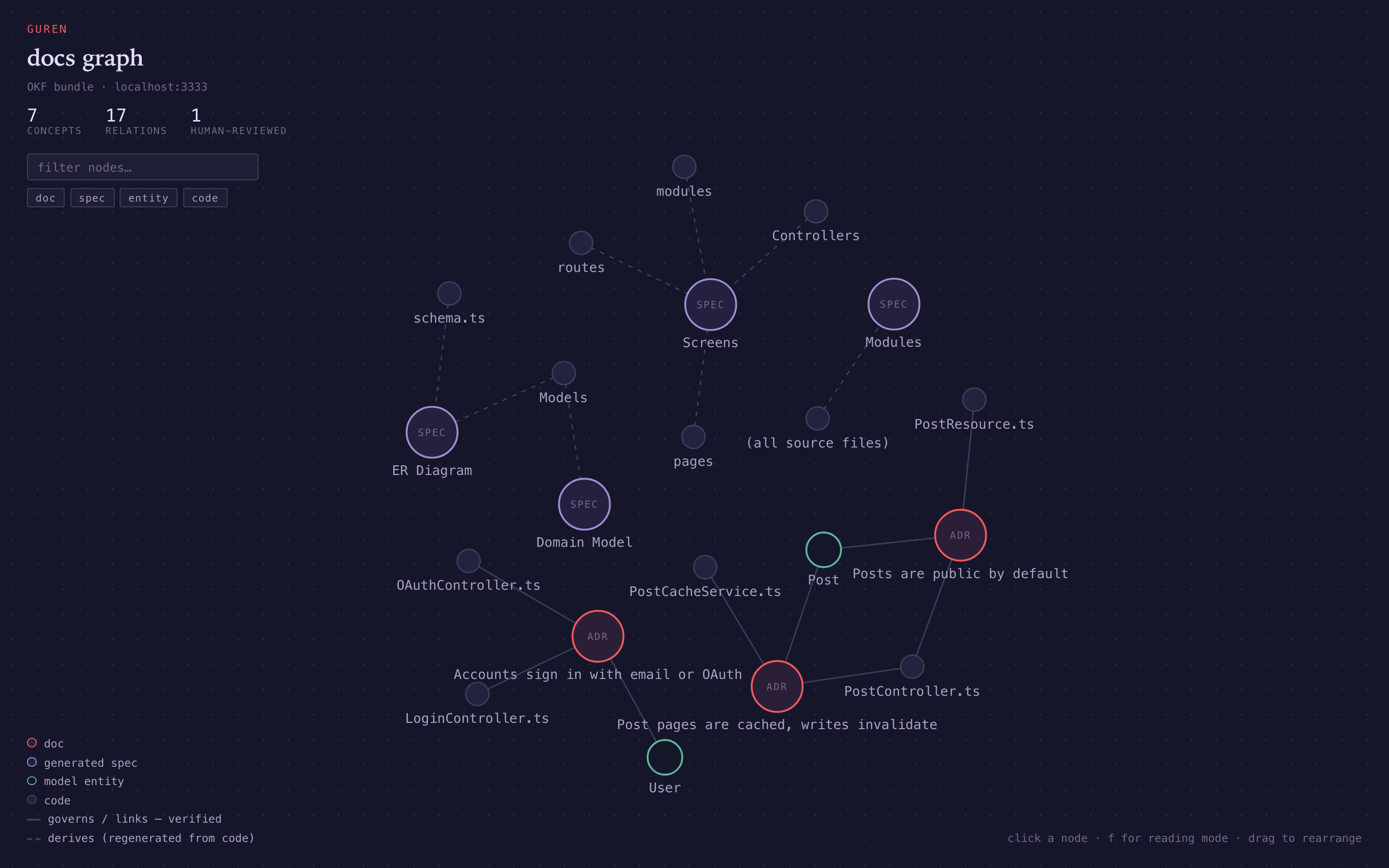
/_guren/docs.Measured on 360 runs of 20 tasks across three models, with and without the harness.
- turns with the harness (Sonnet 5, 60 runs each)
- −28%
- cost, at 60/60 vs 58/60 runs passed
- −25%
- runs that ran guren check, harness vs bare (180 each)
- 119vs15
Conventions you know. Types you didn't have.
Controllers you already know
validateBody(), findOrFail() and userOrFail() send the error response themselves.
Types from route to React
Rename a route and every page that links to the old name fails to compile.
Drizzle models, Eloquent manners
Eloquent-style queries, run by Drizzle ORM.
No API layer to babysit
Inertia passes controller props straight to React.
Batteries actually included
Auth, queues, mail, cache and more ship with the framework.
Prototype before the backend
Build the pages on fixtures, show them, then write the controllers.
Fast where it counts
The same app on Guren and on a Node.js MVC framework, under identical conditions. The code is held constant, so the difference is Bun.
2.3×
SSR throughput
3.5×
JSON API throughput
1.8×
Faster cold starts
Develop on Bun. Ship where you want.
Pick a target, add its plugin, ship the same app.
- Bun serverAny VPS or container, on the runtime you develop on.
$ bunx guren deploy --target dockerGuide - Cloudflare WorkersWorkers and D1 at the edge. This site runs there.
$ bunx guren plugin @guren/plugin-cloudflareGuide - VercelRuns on Vercel's Bun runtime.
$ bunx guren plugin @guren/plugin-vercelGuide - AWS LambdaA handler adapter with Node-compatible defaults.
$ bunx guren plugin @guren/plugin-lambdaGuide
Your first app is one command away
Guren v2 is stable. New apps start on SQLite with nothing to set up.
Postgres, an API-only app, or a coding agent to set it up? Pick your options and copy the command or the prompt.