
Chapter 4: Validation and Resources
Chapter 3 put a schema inside the controller and sent raw field maps to the pages. This chapter gives both a proper home: a validator file that the route, the controller and the form all share, with messages a person would write; and a resource class that decides what a post looks like to the browser. Then you specify editing, deleting and pagination with tests, hand them to the agent, and use the code-review subagent as a second reader before you accept.
Chapter 4: Validation and Resources
Chapter 3 put a schema inside the controller and sent raw field maps to the pages. This chapter gives both a proper home: a validator file that the route, the controller and the form all share, with messages a person would write; and a resource class that decides what a post looks like to the browser. Then you specify editing, deleting and pagination with tests, hand them to the agent, and use the code-review subagent as a second reader before you accept.
What you'll learn:
- Where validation lives, and how one Zod schema types the route contract, the controller, and the form
- What a failed validation answers to a JSON request and to an Inertia form, and how the messages reach
form.errors - What a resource is for, and why the pages never see a raw record
- How
Data.Postin the generated manifests follows the resource - How to ask a subagent to review a change, and what to do with its answer
Start the dev server if it is not running:
bun run dev1. The test first: messages a person would write
Submit an empty form to POST /posts today and the schema rejects it, but with Zod's own wording. Say what you want instead. Add one test to tests/PostController.test.ts:
tests/PostController.test.tsimport { beforeAll, beforeEach, describe, expect, it } from 'bun:test'
import { TestApp } from '@guren/testing'
import app from '../src/app.js'
import { resetDatabase } from '../config/database.js'
import { Post } from '../app/Models/Post.js'

describe('PostController', () => {
  let http: TestApp

  beforeAll(async () => {
    http = await TestApp.fromApp(app)
  })

  beforeEach(async () => {
    await resetDatabase()
  })

  it('lists posts, newest first', async () => {
    await Post.create({ title: 'First post', body: 'Hello' })
    await Post.create({ title: 'Second post', body: 'Again' })

    const response = await http.get('/posts').assertOk()
    const html = await response.text()
    const first = html.indexOf('First post')
    const second = html.indexOf('Second post')
    if (first === -1 || second === -1 || second > first) {
      throw new Error('expected the newer post to be listed before the older one')
    }
  })

  it('shows one post', async () => {
    const post = await Post.create({ title: 'Read me', body: 'The whole body' })

    const response = await http.get(`/posts/${post.id}`).assertOk()
    await response.assertBodyContains('The whole body')
  })

  it('answers 404 for a post that does not exist', async () => {
    await http.get('/posts/999').assertNotFound()
  })

  it('serves the form for a new post', async () => {
    await http.get('/posts/create').assertOk()
  })

  it('stores a post and redirects to it', async () => {
    await http.post('/posts', { title: 'Written in a test', body: 'By a test' }).assertRedirect()

    const post = await Post.where('title', 'Written in a test').first()
    expect(post).not.toBeNull()
    expect(post?.body).toBe('By a test')
  })

  it('rejects an empty post with a message per field', async () => {
    await http
      .post('/posts', { title: '', body: '' })
      .assertStatus(422)
      .assertJsonPath('errors.title.0', 'Title is required')
      .assertJsonPath('errors.body.0', 'Body is required')
  })
})
bun testRed on the messages only: the status is already 422. That is what a validation failure answers to a plain JSON request like this test's: status 422, a JSON body with errors keyed by field, each an array of messages. A form Inertia submits gets a different answer, which section 3 shows.
2. The validator
Move the schema out of the controller into a file of its own, and give it the messages. Create app/Http/Validators/PostValidator.ts:
app/Http/Validators/PostValidator.tsimport { z } from 'zod'

export const PostPayloadSchema = z.object({
  title: z.string().trim().min(1, 'Title is required').max(120, 'Title must be 120 characters or fewer'),
  body: z.string().trim().min(1, 'Body is required'),
})

export type PostPayload = z.infer<typeof PostPayloadSchema>
Now bind it to the route. Replace routes/web.ts:
routes/web.tsimport { Router } from '@guren/core'
import HomeController from '../app/Http/Controllers/HomeController.js'
import AboutController from '../app/Http/Controllers/AboutController.js'
import ContactController from '../app/Http/Controllers/ContactController.js'
import PostController from '../app/Http/Controllers/PostController.js'
import { Post } from '../app/Models/Post.js'
import { PostPayloadSchema } from '../app/Http/Validators/PostValidator.js'

export function registerWebRoutes(router: Router): void {
  router.get('/', [HomeController, 'index'])
  router.get('/about', [AboutController, 'index']).name('about')
  router.get('/contact', [ContactController, 'index']).name('contact')

  router.group('/posts', (posts) => {
    posts.get('/', [PostController, 'index']).name('posts.index')
    posts.get('/create', [PostController, 'create']).name('posts.create')
    posts.get('/:id', { bind: { id: Post }, name: 'posts.show' }, [PostController, 'show'])
    posts.post('/', { name: 'posts.store', body: PostPayloadSchema }, [PostController, 'store'])
  })

  // Health check endpoint for load balancers and uptime monitors
  router.get('/health', (c) => c.json({ status: 'ok' }))
}
body: PostPayloadSchema is a route contract. It does not validate the request by itself; for a controller action, validation is the controller's validateBody() call, and guren audit checks that the call is there. What the contract does is feed codegen: the route's body type becomes part of the generated ApiRoutes, which is what types the form in the next section.
And the controller reads the schema from the validator:
app/Http/Controllers/PostController.tsimport { Controller } from '@guren/core'
import { pages } from '@/.guren/pages.gen'
import { Post } from '../../Models/Post.js'
import { PostPayloadSchema } from '../Validators/PostValidator.js'

export default class PostController extends Controller {
  async index(): Promise<Response> {
    const posts = await Post.orderBy(['id', 'desc'])

    return this.inertia(pages.posts.Index, {
      posts: posts.map((post) => ({ id: post.id, title: post.title, body: post.body })),
    })
  }

  async show(): Promise<Response> {
    const post = this.model(Post)

    return this.inertia(pages.posts.Show, {
      post: { id: post.id, title: post.title, body: post.body, createdAt: post.createdAt },
    })
  }

  async create(): Promise<Response> {
    return this.inertia(pages.posts.New, {})
  }

  async store(): Promise<Response> {
    const data = await this.validateBody(PostPayloadSchema)
    const post = await Post.create(data)
    return this.redirect(`/posts/${post.id}`)
  }
}
bun testGreen. One schema, three readers: the route contract, the controller, and (next) the form.
3. Show the messages
Regenerate the manifests so the route contract reaches the frontend:
bun run codegenThen replace the form. Two changes: its data type is now derived from the route, and it renders form.errors:
resources/js/pages/posts/New.tsximport { Head, useForm } from '@inertiajs/react'
import type { ApiRoutes } from '@/.guren/api-client.gen'
import type { RouteBody } from '@guren/inertia-client/typed-forms'
import { route } from '@/.guren/routes.gen'

type PostForm = RouteBody<ApiRoutes, 'posts.store'>

export default function NewPost() {
  const form = useForm<PostForm>({ title: '', body: '' })

  return (
    <>
      <Head title="New post" />
      <main className="min-h-screen bg-g-page font-sans text-g-text">
        <div className="mx-auto max-w-3xl space-y-6 px-6 py-12">
          <h1 className="text-3xl font-bold text-g-heading">New post</h1>
          <form
            className="space-y-4"
            onSubmit={(event) => {
              event.preventDefault()
              form.post(route('posts.store'))
            }}
          >
            <div>
              <input
                value={form.data.title}
                onChange={(event) => form.setData('title', event.target.value)}
                placeholder="Title"
                className="w-full rounded-g-ctl border border-g-line-strong bg-g-panel px-3 py-2 text-g-text transition outline-none placeholder:text-g-muted focus:border-transparent focus:outline-2 focus:-outline-offset-1 focus:outline-g-accent"
              />
              {form.errors.title && <p className="mt-1 text-sm text-g-danger">{form.errors.title}</p>}
            </div>
            <div>
              <textarea
                value={form.data.body}
                onChange={(event) => form.setData('body', event.target.value)}
                placeholder="Body"
                rows={8}
                className="w-full rounded-g-ctl border border-g-line-strong bg-g-panel px-3 py-2 text-g-text transition outline-none placeholder:text-g-muted focus:border-transparent focus:outline-2 focus:-outline-offset-1 focus:outline-g-accent"
              />
              {form.errors.body && <p className="mt-1 text-sm text-g-danger">{form.errors.body}</p>}
            </div>
            <button type="submit" className="rounded-g-ctl bg-g-accent px-4 py-2 text-sm font-bold text-g-on-accent transition hover:bg-g-accent-down">
              Publish
            </button>
          </form>
        </div>
      </main>
    </>
  )
}
RouteBody<ApiRoutes, 'posts.store'> is { title: string; body: string }, derived from PostPayloadSchema through the route contract. Add a field to the schema and the form's type gains it; misspell a route name and the type is never. You wrote the shape once, in the validator, and it reached the browser without being written again.
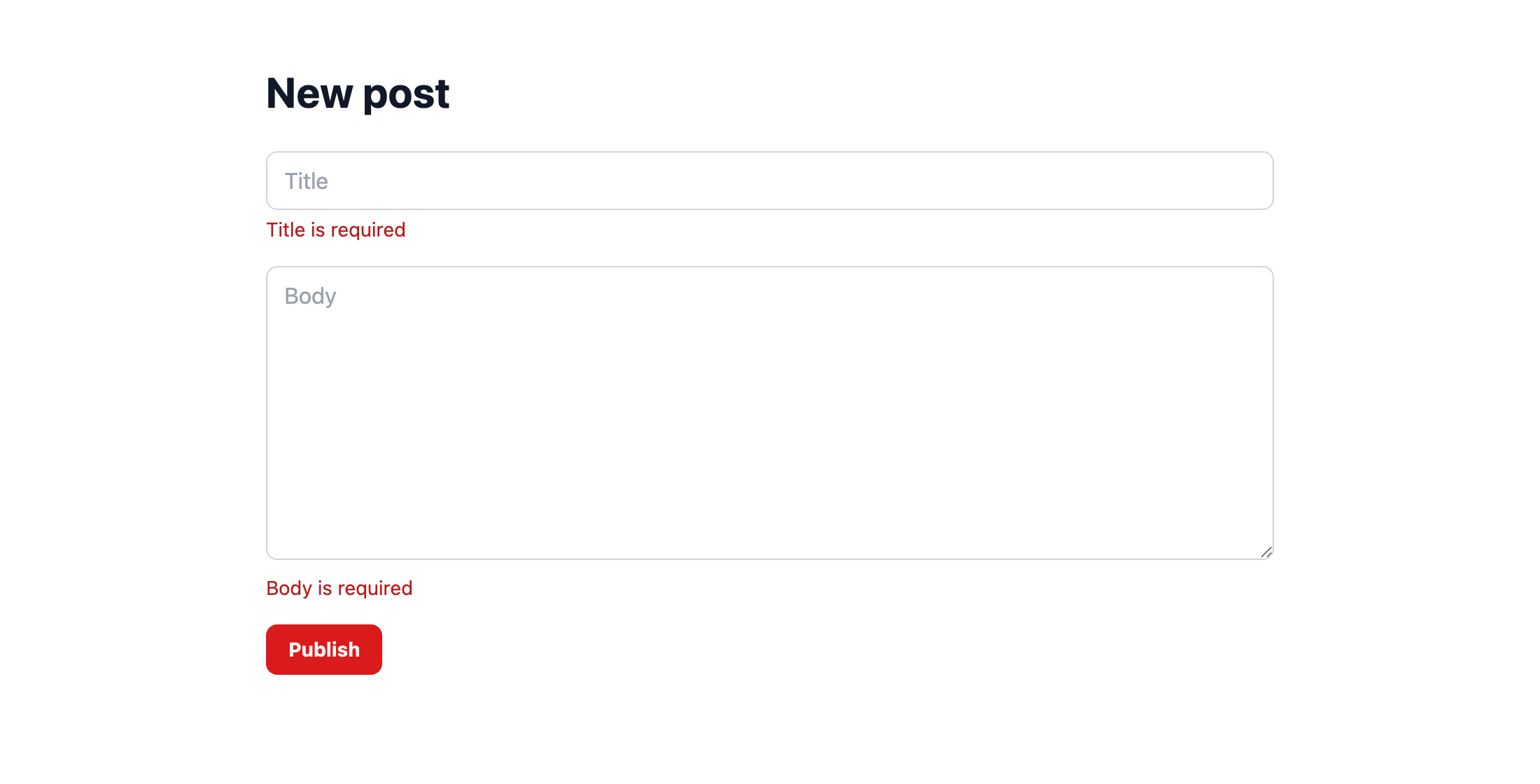
Checkpoint: open http://localhost:3333/posts/create and submit the empty form. "Title is required" under the title, "Body is required" under the body. That request did not get a 422. An Inertia request gets a 303 redirect back to the form, with the messages flashed in a short-lived guren_validation_errors cookie; Inertia followed the redirect, found the messages in form.errors, and re-rendered the same page. You wrote no error handling.
4. The resource
Both index and show build a post-shaped object by hand, and they disagree about which fields it has. That map has a name in Guren: a resource. Create app/Http/Resources/PostResource.ts:
app/Http/Resources/PostResource.tsimport { Resource } from '@guren/core'
import type { PostRecord } from '../../Models/Post.js'

export interface PostResourceData extends Record<string, unknown> {
  id: number
  title: string
  body: string
  createdAt: string
}

export class PostResource extends Resource<PostRecord, PostResourceData> {
  toArray(): PostResourceData {
    return {
      id: this.resource.id,
      title: this.resource.title,
      body: this.resource.body,
      createdAt: this.resource.createdAt,
    }
  }
}
A resource is the one place that decides what a post looks like outside the server. With four columns it looks like ceremony. In chapter 5 the app gains users with password hashes, and the resource is what keeps passwordHash from ever being a prop. The rule from here on: pages never receive a raw record.
Use it in the controller:
app/Http/Controllers/PostController.tsimport { Controller } from '@guren/core'
import { pages } from '@/.guren/pages.gen'
import { Post } from '../../Models/Post.js'
import { PostResource } from '../Resources/PostResource.js'
import { PostPayloadSchema } from '../Validators/PostValidator.js'

export default class PostController extends Controller {
  async index(): Promise<Response> {
    const posts = await Post.orderBy(['id', 'desc'])

    return this.inertia(pages.posts.Index, {
      posts: posts.map((post) => new PostResource(post).toJSON()),
    })
  }

  async show(): Promise<Response> {
    const post = this.model(Post)

    return this.inertia(pages.posts.Show, {
      post: new PostResource(post).toJSON(),
    })
  }

  async create(): Promise<Response> {
    return this.inertia(pages.posts.New, {})
  }

  async store(): Promise<Response> {
    const data = await this.validateBody(PostPayloadSchema)
    const post = await Post.create(data)
    return this.redirect(`/posts/${post.id}`)
  }
}
And let the pages import the shape instead of restating it:
resources/js/pages/posts/Index.tsximport { Head, Link } from '@inertiajs/react'
import type { PostResourceData } from '@/app/Http/Resources/PostResource'
import { route } from '@/.guren/routes.gen'

interface Props {
  posts: PostResourceData[]
}

export default function PostsIndex({ posts }: Props) {
  return (
    <>
      <Head title="Posts" />
      <main className="min-h-screen bg-g-page font-sans text-g-text">
        <div className="mx-auto max-w-3xl space-y-6 px-6 py-12">
          <div className="flex items-center justify-between">
            <h1 className="flex items-center gap-3 text-3xl font-bold text-g-heading">
              <span aria-hidden className="h-7 w-[3px] shrink-0 rounded-full bg-[image:var(--g-tick)]" />
              Posts
            </h1>
            <Link href={route('posts.create')} className="rounded-g-ctl bg-g-accent px-4 py-2 text-sm font-bold text-g-on-accent transition hover:bg-g-accent-down">
              New post
            </Link>
          </div>
          {posts.length === 0 && <p className="text-g-text-2">No posts yet.</p>}
          <div className="space-y-4">
            {posts.map((post) => (
              <article key={post.id} className="rounded-g-card border border-g-line bg-g-panel p-4 shadow-g-card">
                <Link href={route('posts.show', { id: post.id })} className="text-xl font-bold text-g-heading transition hover:text-g-accent-text">
                  {post.title}
                </Link>
                <p className="mt-2 text-sm text-g-text-2">{post.body}</p>
              </article>
            ))}
          </div>
        </div>
      </main>
    </>
  )
}
resources/js/pages/posts/Show.tsximport { Head, Link } from '@inertiajs/react'
import type { PostResourceData } from '@/app/Http/Resources/PostResource'
import { route } from '@/.guren/routes.gen'

interface Props {
  post: PostResourceData
}

export default function PostShow({ post }: Props) {
  return (
    <>
      <Head title={post.title} />
      <main className="min-h-screen bg-g-page font-sans text-g-text">
        <div className="mx-auto max-w-3xl space-y-6 px-6 py-12">
          <Link href={route('posts.index')} className="text-sm text-g-accent-text transition hover:underline">
            All posts
          </Link>
          <h1 className="text-3xl font-bold text-g-heading">{post.title}</h1>
          <p className="font-mono text-xs text-g-text-2">{post.createdAt}</p>
          <p className="whitespace-pre-wrap text-lg">{post.body}</p>
        </div>
      </main>
    </>
  )
}
bun run codegenCodegen noticed the resource: .guren/data.gen.ts now exports Data.Post, the same shape as PostResourceData, for any code that wants to name a post without importing the resource. Run everything:
bun testGreen, and nothing observable changed. That is what a refactor under tests looks like.
bunx guren gategit add -A
git commit -m "feat: validate posts with messages and shape them with a resource"5. Specify the rest of the CRUD
Edit, update, delete, and pagination at ten per page. Replace the test file:
tests/PostController.test.tsimport { beforeAll, beforeEach, describe, expect, it } from 'bun:test'
import { TestApp } from '@guren/testing'
import app from '../src/app.js'
import { resetDatabase } from '../config/database.js'
import { Post } from '../app/Models/Post.js'

describe('PostController', () => {
  let http: TestApp

  beforeAll(async () => {
    http = await TestApp.fromApp(app)
  })

  beforeEach(async () => {
    await resetDatabase()
  })

  it('lists posts, newest first', async () => {
    await Post.create({ title: 'First post', body: 'Hello' })
    await Post.create({ title: 'Second post', body: 'Again' })

    const response = await http.get('/posts').assertOk()
    const html = await response.text()
    const first = html.indexOf('First post')
    const second = html.indexOf('Second post')
    if (first === -1 || second === -1 || second > first) {
      throw new Error('expected the newer post to be listed before the older one')
    }
  })

  it('paginates ten posts per page', async () => {
    for (let i = 1; i <= 11; i++) {
      await Post.create({ title: `Post ${String(i).padStart(2, '0')}`, body: `Body number ${i}` })
    }

    const firstPage = await http.get('/posts').assertOk()
    await firstPage.assertBodyContains('Post 11')
    await firstPage.assertBodyContains('Post 02')
    expect(await firstPage.text()).not.toContain('Post 01')

    const secondPage = await http.get('/posts?page=2').assertOk()
    await secondPage.assertBodyContains('Post 01')
    expect(await secondPage.text()).not.toContain('Post 02')
  })

  it('shows one post', async () => {
    const post = await Post.create({ title: 'Read me', body: 'The whole body' })

    const response = await http.get(`/posts/${post.id}`).assertOk()
    await response.assertBodyContains('The whole body')
  })

  it('answers 404 for a post that does not exist', async () => {
    await http.get('/posts/999').assertNotFound()
  })

  it('serves the form for a new post', async () => {
    await http.get('/posts/create').assertOk()
  })

  it('stores a post and redirects to it', async () => {
    await http.post('/posts', { title: 'Written in a test', body: 'By a test' }).assertRedirect()

    const post = await Post.where('title', 'Written in a test').first()
    expect(post).not.toBeNull()
    expect(post?.body).toBe('By a test')
  })

  it('rejects an empty post with a message per field', async () => {
    await http
      .post('/posts', { title: '', body: '' })
      .assertStatus(422)
      .assertJsonPath('errors.title.0', 'Title is required')
      .assertJsonPath('errors.body.0', 'Body is required')
  })

  it('serves the edit form with the post in it', async () => {
    const post = await Post.create({ title: 'Before', body: 'The old body' })

    const response = await http.get(`/posts/${post.id}/edit`).assertOk()
    await response.assertBodyContains('The old body')
  })

  it('updates a post and redirects to it', async () => {
    const post = await Post.create({ title: 'Before', body: 'The old body' })

    await http.put(`/posts/${post.id}`, { title: 'After', body: 'The new body' }).assertRedirect(`/posts/${post.id}`)

    const updated = await Post.findOrFail(post.id)
    expect(updated.title).toBe('After')
    expect(updated.body).toBe('The new body')
  })

  it('rejects an invalid update with the same messages', async () => {
    const post = await Post.create({ title: 'Before', body: 'The old body' })

    await http
      .put(`/posts/${post.id}`, { title: '', body: 'Still here' })
      .assertStatus(422)
      .assertJsonPath('errors.title.0', 'Title is required')
  })

  it('deletes a post and redirects to the list', async () => {
    const post = await Post.create({ title: 'Doomed', body: 'Gone soon' })

    await http.delete(`/posts/${post.id}`).assertRedirect('/posts')

    expect(await Post.find(post.id)).toBeNull()
  })
})
bun testFive red. Read them once more before delegating: they say the edit page carries the post, that update and delete redirect where a reader would expect, that an invalid update fails the same way an invalid create does, and that the eleventh post falls onto page two. That is a complete specification of the slice.
6. Delegate it
Ask your agent:
Complete the posts CRUD. Add `edit`, `update` and `destroy` actions to `PostController` using route model binding like `show`, and register `GET /posts/:id/edit` (`posts.edit`), `PUT /posts/:id` (`posts.update`, with `body: PostPayloadSchema`) and `DELETE /posts/:id` (`posts.destroy`). Add `resources/js/pages/posts/Edit.tsx` as a form like `New.tsx` that submits with `form.put`, and give `Show.tsx` an Edit link and a Delete button. Paginate `index` at ten posts per page with `Post.paginate` and the `paginate` helper, validating `?page=` with a `ListPostsQuerySchema` in the validator, and render the page links in `Index.tsx`. Use `PostResource` for every post sent to a page. `tests/PostController.test.ts` describes all of it; make it pass.This is the biggest slice so far, which makes it the right place for this chapter's harness lever: the code-review subagent in .claude/agents/code-review.md. A subagent is an agent with its own brief and its own context, invoked by the main agent; this one's brief is a Guren code review. It runs guren check and guren audit first, then reads the diff for what neither of them settles. When your agent reports done, before you run the rubric yourself, ask:
Use the code-review subagent to review the uncommitted changes.Read what comes back beside your own rubric below. A second reader with a fixed brief catches a different set of things than a first reader in the middle of the work, and it costs you one sentence. In chapter 8 you will write that brief yourself.
No agent handy? Six files. The validator gains the query schema:
app/Http/Validators/PostValidator.tsimport { z } from 'zod'

export const PostPayloadSchema = z.object({
  title: z.string().trim().min(1, 'Title is required').max(120, 'Title must be 120 characters or fewer'),
  body: z.string().trim().min(1, 'Body is required'),
})

export type PostPayload = z.infer<typeof PostPayloadSchema>

export const ListPostsQuerySchema = z.object({
  page: z.coerce.number().int().min(1).default(1),
})
app/Http/Controllers/PostController.tsimport { Controller, paginate, type PaginatedPageProps } from '@guren/core'
import { pages } from '@/.guren/pages.gen'
import { Post } from '../../Models/Post.js'
import { PostResource, type PostResourceData } from '../Resources/PostResource.js'
import { ListPostsQuerySchema, PostPayloadSchema } from '../Validators/PostValidator.js'

type PostsIndexProps = PaginatedPageProps<PostResourceData>

export default class PostController extends Controller {
  async index(): Promise<Response> {
    const { page } = this.validateQuery(ListPostsQuerySchema)
    const result = await Post.paginate({ page, perPage: 10, orderBy: ['id', 'desc'] })
    const paginator = paginate(result, { path: this.request.path ?? '/posts' })

    return this.inertia(pages.posts.Index, {
      data: result.data.map((post) => new PostResource(post).toJSON()),
      pagination: {
        meta: paginator.meta(),
        links: paginator.links(),
      },
    } satisfies PostsIndexProps)
  }

  async show(): Promise<Response> {
    const post = this.model(Post)

    return this.inertia(pages.posts.Show, {
      post: new PostResource(post).toJSON(),
    })
  }

  async create(): Promise<Response> {
    return this.inertia(pages.posts.New, {})
  }

  async store(): Promise<Response> {
    const data = await this.validateBody(PostPayloadSchema)
    const post = await Post.create(data)
    return this.redirect(`/posts/${post.id}`)
  }

  async edit(): Promise<Response> {
    const post = this.model(Post)

    return this.inertia(pages.posts.Edit, {
      post: new PostResource(post).toJSON(),
    })
  }

  async update(): Promise<Response> {
    const post = this.model(Post)
    const data = await this.validateBody(PostPayloadSchema)
    await Post.update({ id: post.id }, data)
    return this.redirect(`/posts/${post.id}`)
  }

  async destroy(): Promise<Response> {
    const post = this.model(Post)
    await Post.delete({ id: post.id })
    return this.redirect('/posts')
  }
}
routes/web.tsimport { Router } from '@guren/core'
import HomeController from '../app/Http/Controllers/HomeController.js'
import AboutController from '../app/Http/Controllers/AboutController.js'
import ContactController from '../app/Http/Controllers/ContactController.js'
import PostController from '../app/Http/Controllers/PostController.js'
import { Post } from '../app/Models/Post.js'
import { PostPayloadSchema } from '../app/Http/Validators/PostValidator.js'

export function registerWebRoutes(router: Router): void {
  router.get('/', [HomeController, 'index'])
  router.get('/about', [AboutController, 'index']).name('about')
  router.get('/contact', [ContactController, 'index']).name('contact')

  router.group('/posts', (posts) => {
    posts.get('/', [PostController, 'index']).name('posts.index')
    posts.get('/create', [PostController, 'create']).name('posts.create')
    posts.get('/:id', { bind: { id: Post }, name: 'posts.show' }, [PostController, 'show'])
    posts.get('/:id/edit', { bind: { id: Post }, name: 'posts.edit' }, [PostController, 'edit'])
    posts.post('/', { name: 'posts.store', body: PostPayloadSchema }, [PostController, 'store'])
    posts.put('/:id', { bind: { id: Post }, name: 'posts.update', body: PostPayloadSchema }, [PostController, 'update'])
    posts.delete('/:id', { bind: { id: Post }, name: 'posts.destroy' }, [PostController, 'destroy'])
  })

  // Health check endpoint for load balancers and uptime monitors
  router.get('/health', (c) => c.json({ status: 'ok' }))
}
resources/js/pages/posts/Index.tsximport { Head, Link } from '@inertiajs/react'
import type { PaginatedPageProps } from '@guren/core'
import type { PostResourceData } from '@/app/Http/Resources/PostResource'
import { route } from '@/.guren/routes.gen'

interface Props extends PaginatedPageProps<PostResourceData> {}

export default function PostsIndex({ data, pagination }: Props) {
  return (
    <>
      <Head title="Posts" />
      <main className="min-h-screen bg-g-page font-sans text-g-text">
        <div className="mx-auto max-w-3xl space-y-6 px-6 py-12">
          <div className="flex items-center justify-between">
            <h1 className="flex items-center gap-3 text-3xl font-bold text-g-heading">
              <span aria-hidden className="h-7 w-[3px] shrink-0 rounded-full bg-[image:var(--g-tick)]" />
              Posts
            </h1>
            <Link href={route('posts.create')} className="rounded-g-ctl bg-g-accent px-4 py-2 text-sm font-bold text-g-on-accent transition hover:bg-g-accent-down">
              New post
            </Link>
          </div>
          {data.length === 0 && <p className="text-g-text-2">No posts yet.</p>}
          <div className="space-y-4">
            {data.map((post) => (
              <article key={post.id} className="rounded-g-card border border-g-line bg-g-panel p-4 shadow-g-card">
                <Link href={route('posts.show', { id: post.id })} className="text-xl font-bold text-g-heading transition hover:text-g-accent-text">
                  {post.title}
                </Link>
                <p className="mt-2 text-sm text-g-text-2">{post.body}</p>
              </article>
            ))}
          </div>
          {pagination?.links?.pages && pagination.links.pages.length > 1 && (
            <nav className="flex gap-2 font-mono text-sm">
              {pagination.links.pages.map((page) => (
                <Link key={page.page} href={page.url ?? '#'} className="rounded-g-ctl border border-g-line px-3 py-1 text-g-text-2 transition hover:border-g-line-strong hover:text-g-heading">
                  {page.page}
                </Link>
              ))}
            </nav>
          )}
        </div>
      </main>
    </>
  )
}
resources/js/pages/posts/Show.tsximport { Head, Link } from '@inertiajs/react'
import type { PostResourceData } from '@/app/Http/Resources/PostResource'
import { route } from '@/.guren/routes.gen'

interface Props {
  post: PostResourceData
}

export default function PostShow({ post }: Props) {
  return (
    <>
      <Head title={post.title} />
      <main className="min-h-screen bg-g-page font-sans text-g-text">
        <div className="mx-auto max-w-3xl space-y-6 px-6 py-12">
          <Link href={route('posts.index')} className="text-sm text-g-accent-text transition hover:underline">
            All posts
          </Link>
          <h1 className="text-3xl font-bold text-g-heading">{post.title}</h1>
          <p className="font-mono text-xs text-g-text-2">{post.createdAt}</p>
          <p className="whitespace-pre-wrap text-lg">{post.body}</p>
          <div className="flex items-center gap-4">
            <Link href={route('posts.edit', { id: post.id })} className="text-g-accent-text transition hover:underline">
              Edit
            </Link>
            <Link
              href={route('posts.destroy', { id: post.id })}
              method="delete"
              as="button"
              onBefore={() => window.confirm('Delete this post?')}
              className="rounded-g-ctl border border-g-danger-chip px-3 py-1 text-sm font-bold text-g-danger transition hover:bg-g-danger-tint"
            >
              Delete
            </Link>
          </div>
        </div>
      </main>
    </>
  )
}
resources/js/pages/posts/Edit.tsximport { Head, useForm } from '@inertiajs/react'
import type { ApiRoutes } from '@/.guren/api-client.gen'
import type { RouteBody } from '@guren/inertia-client/typed-forms'
import type { PostResourceData } from '@/app/Http/Resources/PostResource'
import { route } from '@/.guren/routes.gen'

type PostForm = RouteBody<ApiRoutes, 'posts.update'>

interface Props {
  post: PostResourceData
}

export default function EditPost({ post }: Props) {
  const form = useForm<PostForm>({ title: post.title, body: post.body })

  return (
    <>
      <Head title={`Edit: ${post.title}`} />
      <main className="min-h-screen bg-g-page font-sans text-g-text">
        <div className="mx-auto max-w-3xl space-y-6 px-6 py-12">
          <h1 className="text-3xl font-bold text-g-heading">Edit post</h1>
          <form
            className="space-y-4"
            onSubmit={(event) => {
              event.preventDefault()
              form.put(route('posts.update', { id: post.id }))
            }}
          >
            <div>
              <input
                value={form.data.title}
                onChange={(event) => form.setData('title', event.target.value)}
                placeholder="Title"
                className="w-full rounded-g-ctl border border-g-line-strong bg-g-panel px-3 py-2 text-g-text transition outline-none placeholder:text-g-muted focus:border-transparent focus:outline-2 focus:-outline-offset-1 focus:outline-g-accent"
              />
              {form.errors.title && <p className="mt-1 text-sm text-g-danger">{form.errors.title}</p>}
            </div>
            <div>
              <textarea
                value={form.data.body}
                onChange={(event) => form.setData('body', event.target.value)}
                placeholder="Body"
                rows={8}
                className="w-full rounded-g-ctl border border-g-line-strong bg-g-panel px-3 py-2 text-g-text transition outline-none placeholder:text-g-muted focus:border-transparent focus:outline-2 focus:-outline-offset-1 focus:outline-g-accent"
              />
              {form.errors.body && <p className="mt-1 text-sm text-g-danger">{form.errors.body}</p>}
            </div>
            <button type="submit" className="rounded-g-ctl bg-g-accent px-4 py-2 text-sm font-bold text-g-on-accent transition hover:bg-g-accent-down">
              Save
            </button>
          </form>
        </div>
      </main>
    </>
  )
}
Regenerate and run the specification:
bun run codegenbun testThe rubric, alongside whatever the subagent said:
updateanddestroyresolve the post throughthis.model(Post), andupdatevalidates with the samePostPayloadSchemaasstore. The routes for both carrybindand, forupdate,body.indexvalidates?page=withvalidateQueryand a schema; a bareNumber(query.page)is a finding.- Every post that reaches a page goes through
PostResource. The edit page's form type isRouteBody<ApiRoutes, 'posts.update'>. Show.tsxdeletes through amethod="delete"link with a confirmation, not aGETroute that deletes.- All eleven tests are green.
Checkpoint: create twelve posts at http://localhost:3333/posts/create (or fewer, if you are patient with the form), and watch page 2 appear. Edit one; delete one.
bunx guren gatebunx guren auditThree warnings now: POST, PUT and DELETE /posts have no authentication check. Still correct, still deliberate, still chapter 6.
git add -A
git commit -m "feat: complete the posts CRUD with pagination"
Where you are
- A validator file with human-readable messages, bound to the routes, read by the controller, and typing the forms.
- A resource that decides what a post looks like, and a
Data.Posttype that follows it. - Full CRUD and pagination, specified by eleven tests, built by the agent, reviewed by a subagent and by you.
- Three audit warnings you are carrying on purpose.
Common trip-ups
RouteBody<ApiRoutes, 'posts.store'>isnever. The route has nobody:contract, or codegen has not run since you added it. Checkroutes/web.ts, thenbun run codegen.- The 422 test passes but the browser shows no message. The page renders
form.errors.title; check the field name matches the schema key exactly. Inertia only fills in errors for keys the server returned. Post.updatecomplains aboutid.updatetakes awhereobject first and the data second:Post.update({ id }, data). The validated data never contains anid, andfillablewould drop one anyway.- Page 2 shows nothing.
perPageis not 10, ororderByis missing so the pages are in insertion order and the test's expectations about which post lands where do not hold. - The Delete button navigates to a 404.
Linkneedsmethod="delete"; without it, the browser issues aGETto the destroy URL, which is not a route.
Exercises
PostPayloadSchemaalready refuses a title of only spaces. On a branch, find the part of thetitlerule that does it and remove it, then write a test that fails without it and passes once you put it back. Would any existing test have noticed that the rule was gone?- Remove
bodyfromPostResource.toArray()and runbun test. Some tests fail; the page still renders. What does that tell you about where a resource's contract is actually checked?
Exercise 1: hint and an example answer
Read the title line in app/Http/Validators/PostValidator.ts: .trim() runs before .min(1), so ' ' becomes '' and fails with "Title is required". Remove .trim() and write the test with a title of spaces only:
it('rejects a title of only spaces', async () => {
  await http
    .post('/posts', { title: '   ', body: 'Some body' })
    .assertStatus(422)
    .assertJsonPath('errors.title.0', 'Title is required')
})
Without .trim() the spaces pass .min(1), the post is stored and the request redirects, so the test fails. Put .trim() back and it passes. As for an existing test noticing the removal: none would. "rejects an empty post with a message per field" sends '', which fails .min(1) with or without .trim(), so that test stays green whether the rule exists or not. That is why the new test is worth keeping.
Exercise 2: hint and an example answer
bun test runs your TypeScript without type-checking it. Run bun run typecheck as well and compare the two.
The tests that fail are the ones that look for a body in the response: "shows one post" and "serves the edit form with the post in it". The list tests look only for titles, so they pass. The page renders because nothing checks the props at runtime: post.body is undefined, and React renders nothing for it. The contract is checked at compile time. toArray() declares that it returns PostResourceData, which requires body, so bun run typecheck fails in app/Http/Resources/PostResource.ts. Remove body from the interface as well, and it fails in the pages that read post.body instead. The gate runs typecheck before the tests, so it would have stopped there.
Next
Chapter 5: Users and Passwords gives the users table a model, hashes passwords, and builds registration, login and logout by hand.