
Chapter 4: One Step at a Time
The plan is approved. In this chapter the agent builds it. Guren splits the plan into steps; the agent takes one, implements it, has it verified, and commits. Your part is to read each commit before the next one lands.
Chapter 4: One Step at a Time
The plan is approved. In this chapter the agent builds it. Guren splits the plan into steps; the agent takes one, implements it, has it verified, and commits. Your part is to read each commit before the next one lands.
What you'll learn:
- How a plan becomes steps, and what each kind of step writes
- What "verified" means, and who decides it
- What to check in each step's commit
1. The steps
Guren derives the steps from the plan; nobody writes them. This plan has one entity, so it gets one task of five steps:
flowchart LR
  S["scaffold<br/>generated code"] --> T["tests<br/>red, one per behaviour"] --> D["data<br/>migration"] --> H["http<br/>actions, policy, pages"] --> P["pages<br/>typecheck, check"]
Every step runs the same loop:
flowchart LR
  Next["plan:next<br/>marks the step"] --> Work["implement<br/>that step only"] --> Verify["plan:verify<br/>runs its commands"] --> Commit["commit"]
  Commit --> Next
plan:verify runs the step's commands (codegen, typecheck, guren check, the migration, the tests) and records the result under .guren/plans/, which git ignores. A step is verified when its commands pass and the plan elements it covers read as built in the code. The agent's opinion is not an input.
2. Start the agent
Send this prompt to the Claude Code session:
Implement docs/plans/meetups/plan.json with the plan-implement skill. One commit per step. Stop when plan:next says every step is verified.The agent now runs the loop by itself. When it tries to end its turn early, the Stop hook from chapter 1 verifies the marked step and sends the agent back if the step is not verified.
While it works, follow along in your own terminal:
git log --onelineEach commit names its step in brackets. Read each one as it lands, using the checklist in section 4.
3. The steps, one by one
This section shows what each step produces. With an agent, you only read it. Without one, run each block.
scaffold
bunx guren plan:next docs/plans/meetups/plan.json
bunx guren plan:scaffold docs/plans/meetups/plan.json --step task/entity/model.meetup/scaffold
bunx guren plan:verify docs/plans/meetups/plan.json --step task/entity/model.meetup/scaffold
git add -A
git commit -m "feat(meetups): scaffold [task/entity/model.meetup/scaffold]"
plan:scaffold writes the code the plan fully determines: the meetups table in db/schema.ts, the Meetup model, the validator, the resource, a policy that denies everything, a controller whose actions answer 501, and routes/meetups.ts, not yet mounted. Nobody writes these by hand, the agent included.
tests
bunx guren plan:next docs/plans/meetups/plan.json
bunx guren plan:scaffold docs/plans/meetups/plan.json --step task/entity/model.meetup/tests
This writes tests/plans/meetups/meetups.test.ts: one test per behaviour, titled [AC-meetups-1] …, each with its request already written. What it cannot write is the setup, the rows and the signed-in user a behaviour assumes. Each test stops at a given('…') call naming that setup, and filling those in is the step's work.
tests/plans/meetups/meetups.test.ts, with the setup written
tests/plans/meetups/meetups.test.tsimport { beforeEach, describe, expect, test } from 'bun:test'
import { TestApp } from '@guren/testing'
import { resetDatabase } from '../../../config/database.js'
import { Meetup } from '../../../app/Models/Meetup.js'
import { User, type UserRecord } from '../../../app/Models/User.js'

let booted: Promise<TestApp> | undefined

function ready(): Promise<TestApp> {
  booted ??= import('../../../src/app.js').then(({ default: app }) => TestApp.fromApp(app))
  return booted
}

async function client(actor?: object): Promise<TestApp> {
  const http = actor === undefined ? await ready() : (await ready()).actingAs(actor)
  return http.withCsrf()
}

let ada: UserRecord
let grace: UserRecord

function meetupBy(organizer: UserRecord) {
  return Meetup.forceCreate({ title: 'Bun night', startsAt: '2026-10-20T19:00', capacity: 20, organizerId: organizer.id })
}

beforeEach(async () => {
  await ready()
  await resetDatabase()
  ada = await User.create({ name: 'Ada', email: 'ada@example.com', password: 'correct horse battery' })
  grace = await User.create({ name: 'Grace', email: 'grace@example.com', password: 'correct horse battery' })
})

describe('Meetup', () => {
  test('[AC-meetups-1] A signed-in user can organize a meetup.', async () => {
    await (await client(ada)).post('/meetups', { title: 'Bun night', startsAt: '2026-10-20T19:00', capacity: 20 }).assertStatus(303)
    const meetup = await Meetup.where({ title: 'Bun night' }).first()
    expect(meetup?.organizerId).toBe(ada.id)
  })

  test('[AC-meetups-2] A meetup needs at least one seat.', async () => {
    const response = await (await client(ada)).post('/meetups', { title: 'Bun night', startsAt: '2026-10-20T19:00', capacity: 0 }).assertStatus(422)
    const body = await response.json<{ errors?: Record<string, unknown> }>()
    expect(Object.keys(body.errors ?? {})).toEqual(expect.arrayContaining(['capacity']))
  })

  test('[AC-meetups-3] A guest cannot organize a meetup.', async () => {
    await (await client()).post('/meetups').assertRedirect('/login')
  })

  test('[AC-meetups-4] A user cannot edit someone else\'s meetup.', async () => {
    const meetup = await meetupBy(grace)
    await (await client(ada)).put(`/meetups/${meetup.id}`, { title: 'Taken over', startsAt: '2026-10-20T19:00', capacity: 20 }).assertStatus(403)
  })

  test('[AC-meetups-5] Anyone can see the list of meetups.', async () => {
    await meetupBy(grace)
    const response = await (await client()).get('/meetups').assertStatus(200)
    await response.assertBodyContains('Bun night')
  })

  test('[AC-meetups-6] A guest cannot open the edit form.', async () => {
    const meetup = await meetupBy(grace)
    await (await client()).get(`/meetups/${meetup.id}/edit`).assertRedirect('/login')
  })

  test('[AC-meetups-7] The organizer can edit their meetup.', async () => {
    const meetup = await meetupBy(ada)
    await (await client(ada)).put(`/meetups/${meetup.id}`, { title: 'Bun night 2', startsAt: '2026-10-20T19:00', capacity: 30 }).assertStatus(303)
    expect(await Meetup.where({ title: 'Bun night 2' }).first()).not.toBeNull()
  })

  test('[AC-meetups-8] A guest cannot open the form for a new meetup.', async () => {
    await (await client()).get('/meetups/create').assertRedirect('/login')
  })

  test('[AC-meetups-9] A user cannot open the edit form of someone else\'s meetup.', async () => {
    const meetup = await meetupBy(grace)
    await (await client(ada)).get(`/meetups/${meetup.id}/edit`).assertStatus(403)
  })

  test('[AC-meetups-10] An edit needs at least one seat.', async () => {
    const meetup = await meetupBy(ada)
    const response = await (await client(ada)).put(`/meetups/${meetup.id}`, { title: 'Bun night', startsAt: '2026-10-20T19:00', capacity: 0 }).assertStatus(422)
    const body = await response.json<{ errors?: Record<string, unknown> }>()
    expect(Object.keys(body.errors ?? {})).toEqual(expect.arrayContaining(['capacity']))
  })

  test('[AC-meetups-11] A guest cannot edit a meetup.', async () => {
    const meetup = await meetupBy(grace)
    await (await client()).put(`/meetups/${meetup.id}`).assertRedirect('/login')
  })

  test('[AC-meetups-12] The organizer can open the edit form.', async () => {
    const meetup = await meetupBy(ada)
    await (await client(ada)).get(`/meetups/${meetup.id}/edit`).assertStatus(200)
  })
})
bunx guren plan:verify docs/plans/meetups/plan.json --step task/entity/model.meetup/tests
git add -A
git commit -m "test(meetups): acceptance tests [task/entity/model.meetup/tests]"
This step is verified when every test fails. A test that passes before the code exists proves nothing.
data
bunx guren plan:next docs/plans/meetups/plan.json
bun run db:make create_meetups
bunx guren plan:verify docs/plans/meetups/plan.json --step task/entity/model.meetup/data
git add -A
git commit -m "feat(meetups): migration [task/entity/model.meetup/data]"
db:make generates the migration from the table the scaffold step wrote, and plan:verify applies it.
http
The routes file is mounted by a command, not by hand:
bunx guren plan:next docs/plans/meetups/plan.json
bunx guren plan:scaffold docs/plans/meetups/plan.json --step task/entity/model.meetup/http --mount
Then the stubs become real code. This is the one step where most of the writing happens.
app/Http/Controllers/MeetupController.ts
app/Http/Controllers/MeetupController.tsimport { Controller } from '@guren/core'
import { pages } from '@/.guren/pages.gen'
import { MeetupPayloadSchema } from '../Validators/MeetupValidator.js'
import { MeetupResource } from '../Resources/MeetupResource.js'
import { Meetup } from '../../Models/Meetup.js'
import type { UserRecord } from '../../Models/User.js'

export default class MeetupController extends Controller {
  async index(): Promise<Response> {
    const meetups = await Meetup.orderBy([['startsAt', 'asc']])
    return this.inertia(pages.meetups.Index, { meetups: meetups.map((meetup) => new MeetupResource(meetup).toArray()) })
  }

  async show(): Promise<Response> {
    const meetup = this.model(Meetup)
    return this.inertia(pages.meetups.Show, { meetup: new MeetupResource(meetup).toArray() })
  }

  async create(): Promise<Response> {
    return this.inertia(pages.meetups.Create, {})
  }

  async store(): Promise<Response> {
    const data = await this.validateBody(MeetupPayloadSchema)
    const user = await this.auth.userOrFail<UserRecord>()
    const meetup = await Meetup.forceCreate({ ...data, organizerId: user.id })
    return this.redirect(`/meetups/${meetup.id}`)
  }

  async edit(): Promise<Response> {
    const meetup = this.model(Meetup)
    await this.authorize('update', [Meetup, meetup])
    return this.inertia(pages.meetups.Edit, { meetup: new MeetupResource(meetup).toArray() })
  }

  async update(): Promise<Response> {
    const meetup = this.model(Meetup)
    await this.authorize('update', [Meetup, meetup])
    const data = await this.validateBody(MeetupPayloadSchema)
    await Meetup.update({ id: meetup.id }, data)
    return this.redirect(`/meetups/${meetup.id}`)
  }
}
app/Policies/MeetupPolicy.ts
app/Policies/MeetupPolicy.tsimport { Policy, type AuthUser } from '@guren/core'
import type { MeetupRecord } from '../Models/Meetup.js'

export class MeetupPolicy extends Policy {
  update(user: AuthUser | null, meetup: MeetupRecord): boolean {
    return user !== null && user.id === meetup.organizerId
  }
}
The four pages and the form they share
resources/js/components/MeetupForm.tsximport { useForm } from '@inertiajs/react'

export interface MeetupFormData {
  title: string
  startsAt: string
  capacity: number
}

interface Props {
  initial: MeetupFormData
  submit: (form: ReturnType<typeof useForm<MeetupFormData>>) => void
  label: string
}

const inputClass = 'mt-1 w-full rounded-g-ctl border border-g-line-strong bg-g-panel px-3 py-2 text-g-text'

export default function MeetupForm({ initial, submit, label }: Props) {
  const form = useForm<MeetupFormData>(initial)
  return (
    <form
      className="mt-6 space-y-4"
      onSubmit={(event) => {
        event.preventDefault()
        submit(form)
      }}
    >
      <label className="block text-sm font-bold text-g-heading">
        Title
        <input className={inputClass} value={form.data.title} onChange={(event) => form.setData('title', event.target.value)} />
      </label>
      {form.errors.title && <p className="text-sm text-g-danger">{form.errors.title}</p>}
      <label className="block text-sm font-bold text-g-heading">
        Starts at
        <input type="datetime-local" className={inputClass} value={form.data.startsAt} onChange={(event) => form.setData('startsAt', event.target.value)} />
      </label>
      {form.errors.startsAt && <p className="text-sm text-g-danger">{form.errors.startsAt}</p>}
      <label className="block text-sm font-bold text-g-heading">
        Capacity
        <input type="number" className={inputClass} value={form.data.capacity} onChange={(event) => form.setData('capacity', Number(event.target.value))} />
      </label>
      {form.errors.capacity && <p className="text-sm text-g-danger">{form.errors.capacity}</p>}
      <button type="submit" disabled={form.processing} className="rounded-g-ctl bg-g-accent px-4 py-2 font-bold text-white">
        {label}
      </button>
    </form>
  )
}
resources/js/pages/meetups/Index.tsximport { Head, Link } from '@inertiajs/react'
import Layout from '../../components/Layout.js'
import type { MeetupResourceData } from '@/app/Http/Resources/MeetupResource'

interface Props {
  meetups: MeetupResourceData[]
}

export default function Index({ meetups }: Props) {
  return (
    <Layout>
      <Head title="Meetups" />
      <div className="flex items-center justify-between">
        <h1 className="text-3xl font-bold text-g-heading">Meetups</h1>
        <Link href="/meetups/create" className="text-sm text-g-accent">New meetup</Link>
      </div>
      {meetups.length === 0 ? (
        <p className="mt-6 text-g-text-2">No meetups yet.</p>
      ) : (
        <ul className="mt-6 divide-y divide-g-line">
          {meetups.map((meetup) => (
            <li key={meetup.id} className="py-3">
              <Link href={`/meetups/${meetup.id}`} className="font-bold text-g-heading">{meetup.title}</Link>
              <p className="text-sm text-g-text-2">{meetup.startsAt} · {meetup.capacity} seats</p>
            </li>
          ))}
        </ul>
      )}
    </Layout>
  )
}
resources/js/pages/meetups/Show.tsximport { Head, Link } from '@inertiajs/react'
import Layout from '../../components/Layout.js'
import type { MeetupResourceData } from '@/app/Http/Resources/MeetupResource'

interface Props {
  meetup: MeetupResourceData
}

export default function Show({ meetup }: Props) {
  return (
    <Layout>
      <Head title={meetup.title} />
      <h1 className="text-3xl font-bold text-g-heading">{meetup.title}</h1>
      <p className="mt-2 text-g-text-2">{meetup.startsAt} · {meetup.capacity} seats</p>
      <Link href={`/meetups/${meetup.id}/edit`} className="mt-6 inline-block text-sm text-g-accent">Edit</Link>
    </Layout>
  )
}
resources/js/pages/meetups/Create.tsximport { Head } from '@inertiajs/react'
import Layout from '../../components/Layout.js'
import MeetupForm from '../../components/MeetupForm.js'

export default function Create() {
  return (
    <Layout>
      <Head title="New meetup" />
      <h1 className="text-3xl font-bold text-g-heading">New meetup</h1>
      <MeetupForm
        initial={{ title: '', startsAt: '', capacity: 20 }}
        submit={(form) => form.post('/meetups')}
        label="Create"
      />
    </Layout>
  )
}
resources/js/pages/meetups/Edit.tsximport { Head } from '@inertiajs/react'
import Layout from '../../components/Layout.js'
import MeetupForm from '../../components/MeetupForm.js'
import type { MeetupResourceData } from '@/app/Http/Resources/MeetupResource'

interface Props {
  meetup: MeetupResourceData
}

export default function Edit({ meetup }: Props) {
  return (
    <Layout>
      <Head title={`Edit ${meetup.title}`} />
      <h1 className="text-3xl font-bold text-g-heading">Edit meetup</h1>
      <MeetupForm
        initial={{ title: meetup.title, startsAt: meetup.startsAt, capacity: meetup.capacity }}
        submit={(form) => form.put(`/meetups/${meetup.id}`)}
        label="Save"
      />
    </Layout>
  )
}
bunx guren plan:verify docs/plans/meetups/plan.json --step task/entity/model.meetup/http
git add -A
git commit -m "feat(meetups): controller, policy, pages [task/entity/model.meetup/http]"
This step is verified when every behaviour's test passes.
pages
The http step already needed the pages, since a controller cannot render a page that does not exist. This step checks them on their own: typecheck and guren check.
bunx guren plan:next docs/plans/meetups/plan.json
bunx guren plan:verify docs/plans/meetups/plan.json --step task/entity/model.meetup/pages
4. Read each commit
"Verified" means the tests pass. It does not mean the tests test the right thing, or that the code does only what the plan says. That part is yours, and a commit per step keeps it small:
git show --stat HEAD| Step | Check |
|---|---|
| scaffold | The commit holds only generated files. The agent edited nothing by hand |
| tests | Every title still carries its [AC-…] id. Each setup creates what the behaviour's given says, and no more |
| data | The migration creates meetups and touches nothing else |
| http | this.authorize('update', [Meetup, meetup]) passes the record, not just the class. organizerId comes from this.auth, never from the request. The policy compares ids |
| pages | Nothing, usually. The commands are the check |
The http row carries the rule most worth your attention. The scaffold writes a policy whose update returns false until someone writes the rule. An agent that fills in the controller and forgets the policy leaves a feature nobody can edit, and every forbidden test still passes, since refusing everyone refuses the wrong user too. Only AC-meetups-7 and AC-meetups-12, the organizer's own success behaviours, fail on it. That is row 5 of the checklist in chapter 2, paying off.
5. Where the plan stands
bunx guren plan:next docs/plans/meetups/plan.json"Every step is verified." For the element-by-element view:
bunx guren plan:status docs/plans/meetups/plan.jsonEvery element the plan adds reads verified: found in the code as planned, and covered by a step whose run still holds. The two it only refers to, User and users.id, read present. Change a file an element was verified from, and it reads drifted until the step is verified again.
Start the app and look at what was built:
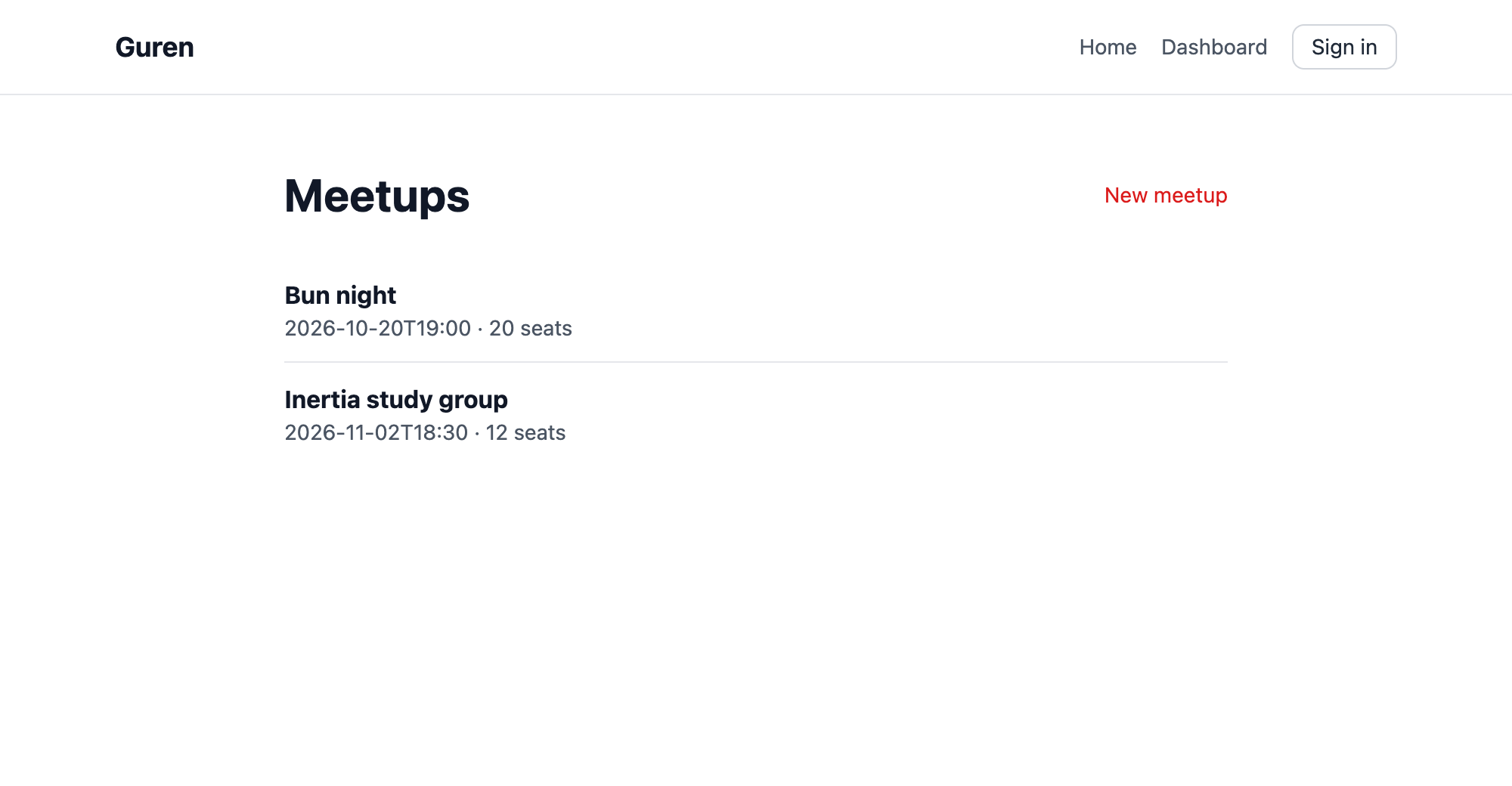
bun run devSign up at /register, then open /meetups.
# Press Ctrl-C in the terminal running bun run dev.Where you are
- Five verified steps, and a commit for each of the four that wrote something.
- A meetups feature you did not type, with twelve passing tests you specified.
- A plan every step of which is verified, ready to close.
Common trip-ups
- Every test fails with "database has not been configured". A
beforeEachof your own touched the database before the app booted. Start it withawait ready(), as the skeleton's header comment says and the reference test does. plan:nextrefuses because the tree is dirty. A step was left uncommitted. Commit it, or discard it, before asking for the next one.- The http step fails on
AC-meetups-7orAC-meetups-12with a 403. The policy still returnsfalse, or the controller passesMeetupalone tothis.authorizeinstead of[Meetup, meetup]. See the http row above. - The agent keeps retrying the same step. After three blocked stops, the Stop hook records the step as stalled with the reason, and lets the agent stop.
plan:nextshows the stall. Read the reason before telling the agent to go on.
Exercises
- On a branch, change the policy to
return trueand runplan:verifyfor the http step. Which behaviours fail? Then switch back without committing. - Run
bunx guren plan:status docs/plans/meetups/plan.json --jsonand find the entry forpolicy.meetup. What does it list underfiles, and why would a change to one of them mark itdrifted?
Exercise 1: hint and an example answer
The auth middleware redirects a guest before the policy runs, and the organizer is let in either way. Only the behaviours where a signed-in user who is not the organizer must be refused depend on the policy.
Two fail: AC-meetups-4 (the PUT on someone else's meetup answers 303, not 403) and AC-meetups-9 (their edit form answers 200, not 403). The other ten pass. This is the mirror image of the scaffold's return false: the forbidden behaviours catch a policy that lets everyone in, and the organizer's success behaviours catch one that lets nobody in.
To go back, first discard the edit with git restore app/Policies/MeetupPolicy.ts, since an uncommitted change follows you across git switch. Then switch back. The failed run replaced the http step's record under .guren/plans/, which git ignores, so on your main branch run bunx guren plan:verify docs/plans/meetups/plan.json --step task/entity/model.meetup/http once more. Otherwise plan:close in chapter 5 refuses.
Exercise 2: hint and an example answer
files lists the files the element was found in. When the step that owns the element verifies, plan:verify records a hash of each of those files under .guren/plans/.
For policy.meetup, it lists the policy's own file, app/Policies/MeetupPolicy.ts. The http step owns the policy and recorded that file's hash when it verified. Change the file, and the hash no longer matches: the "verified" result describes code that is gone. So the element reads drifted until plan:verify runs the http step again.
Next
Chapter 5: Close the Plan turns the finished plan into documentation that stays with the code.